

Online Extras Bonus Section
Exclusively for the Building Strong Families Masterclass participants and Workbook owners.
1. Enroll in the Masterclass
If you haven’t enrolled, enroll here now!. Get the app, watch and/or listen to the lesson videos, complete your reading and worksheet assignments, track your progress, and more
Note: The content in the rest of this Online Bonus Section is free whether you enroll in the Masterclass or not.
2. Videos, articles, media for each BSF Trait
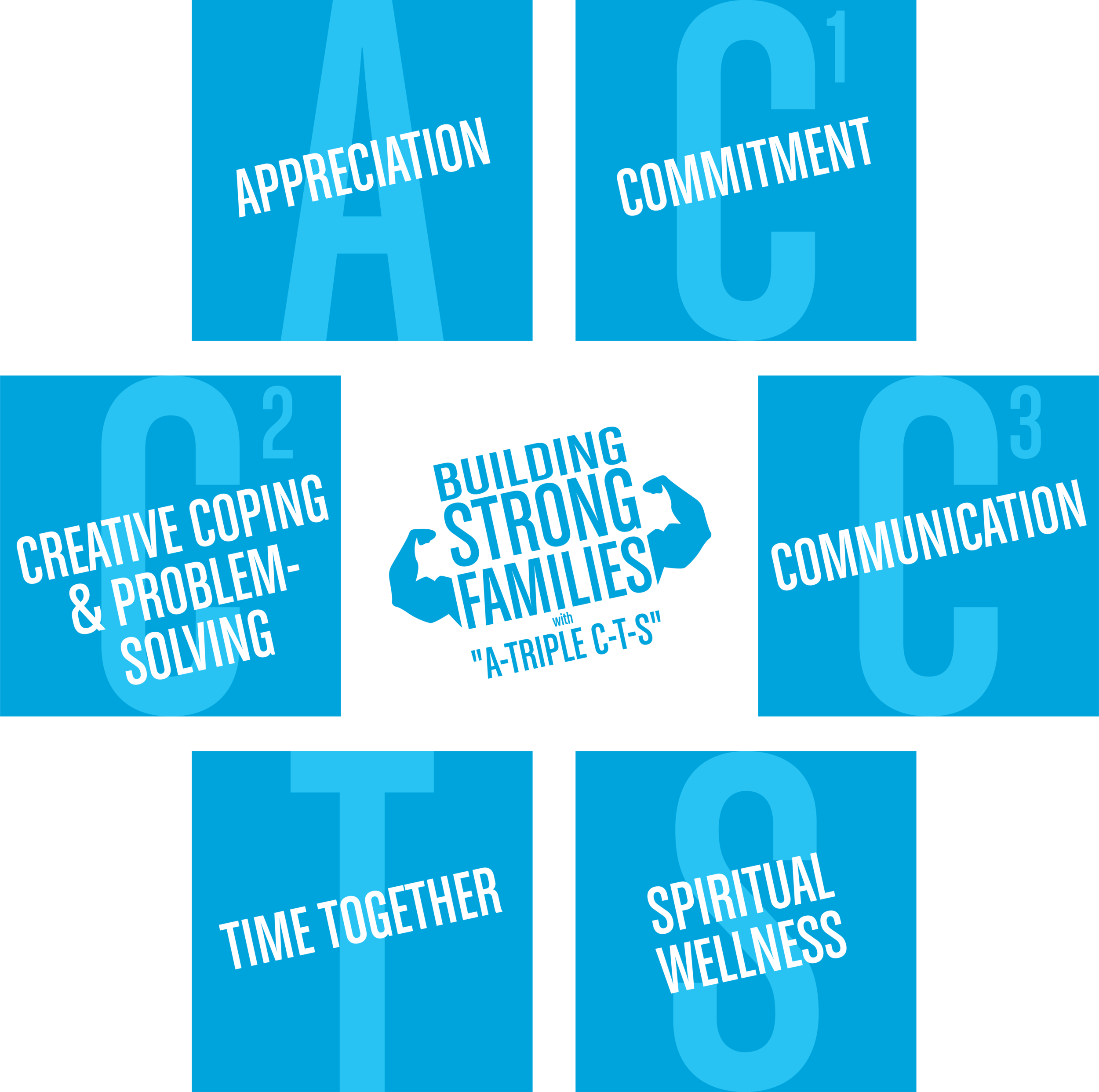
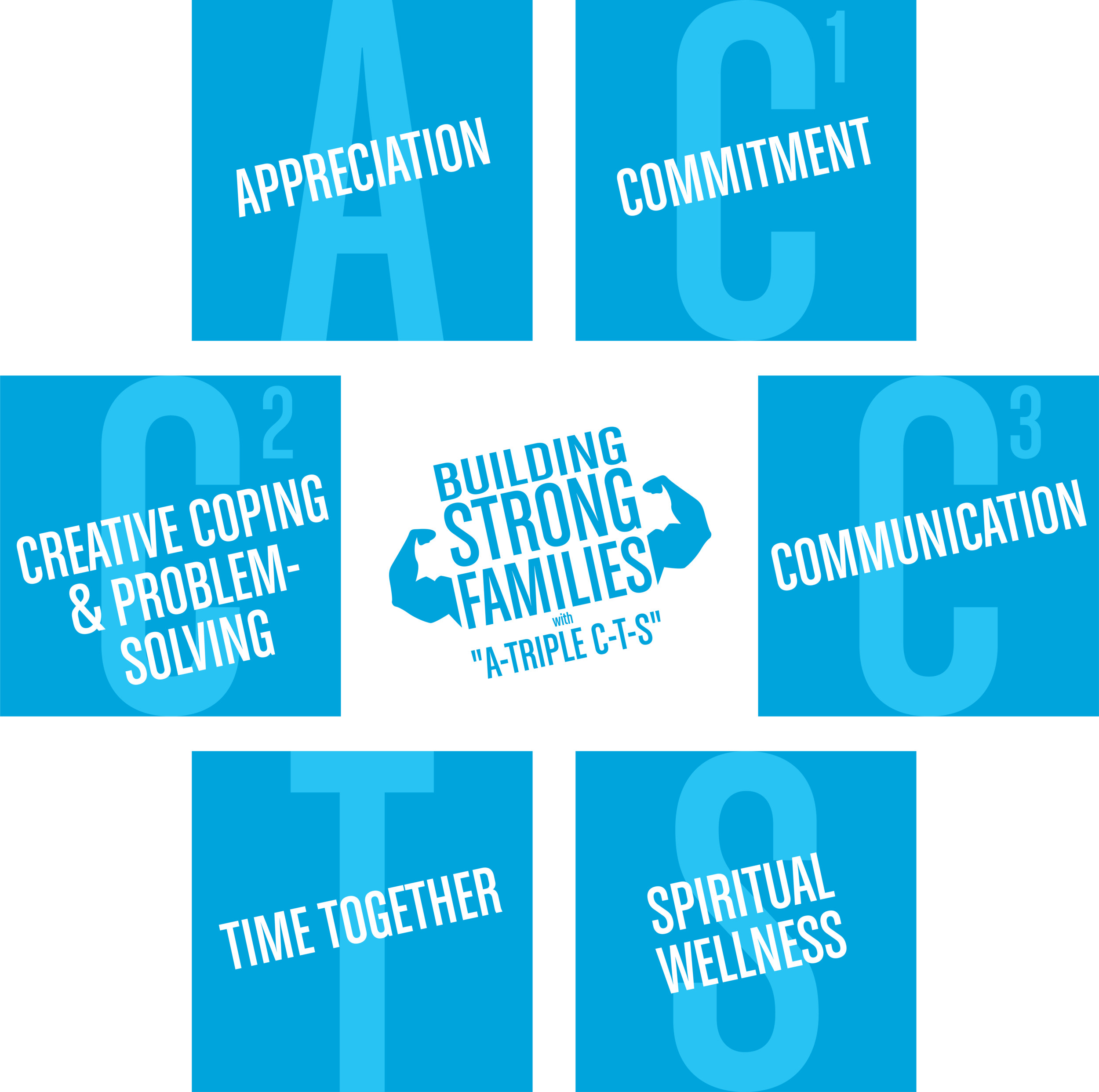
Here on this page below, each of the seven “Double A-Triple C-T-S” traits has its own bonus section of related inspiring, upbeat, encouraging, humorous, and informative resources Jonathan has collected and curated from over 30 years of presenting this course. Due to time constraints, this is ALL the stuff that normally never gets shared in the regular 90-minute workshop. However, now you get ALL the EXTRA goodies :-)
3. PDF copy of the workbook…
is available here so you can download and print extra copies of any worksheets you need for activities for yourself and other immediate family members.
Thank you for your integrity in not sharing this PDF with people outside your immediate family who haven’t purchased it.
You can buy a paperback copy on Amazon here:
Note regarding spiritual/religious content: The Building Strong Family (BSF) program is both secular- and faith-friendly. I respect that BSF course participants and my clients come from widely diverse backgrounds: some are religious (from many various faiths), while others are agnostic or atheist. The BSF course is based on secular research- and evidence-based findings. Also, to help illustrate these concepts, I use examples, stories, and teachings from various philosophies and literature, as well as faiths such as Judaism, Christianity, Hinduism, and Buddhism, among others with which many can relate. For example, the many classic “Homefront” and “Family: Isn't It About Time” series of TV spots are from the Mormons (LDS). Some of you may even remember as children seeing these feel-good commercials on TV when you were growing up in the 70s, 80s, and 90s. They are shared here solely as they illustrate the BSF concepts well: Making our family relationships our number one priority. They are not, however, shared here to endorse or push a particular faith, which is true for any examples I share from various faiths. The TV spots themselves generally do not contain religious messaging or preaching other than at the end of each video, which briefly identifies its denomination. Further, and admittedly, these old commercials may be cheesy and dated. However, they are still positive, upbeat, encouraging, and inspiring with universal, timeless messages about what we all want regardless of religious affiliation: Close, loving relationships with our families.
Intro to the Strong Family Concept
Take the Family Strengths Inventory here. Additional resources as well.
CONTENTS ON THIS PAGE:
PDF: The Building Strong Family Workbook
Course Evaluation Results
PDF: 30 FAQs for Creating GREAT Relationships
PDF: Risk and Protective Factors Worksheet
PDF: Fridge Flyer Reminder Sheets
Vid: Strong families are REAL families with real problems
Cartoons: What’s “normal” anyway?
PDF: The Family Strengths Inventory
PDF: Journal article by one of the pioneers of the research into strong families:
Vid: Only a Person Who Risks is Free
PDF of the Building Strong Family Workbook
Need extra worksheets or handouts from your workbook to use with your family? Download the PDF of the BSF Workbook and print out what you need.
VPlease, do not share this workbook with others who haven’t paid for it. This is for your own personal use as someone who has purchased the online Masterclass, the paperback workbook, or the Kindle eBook. Thank you for your integrity.
Course Evaluation Results
I don't filter my workshop evaluation results; I give them here as straight as I get them. I figure if you're making the important decision to purchase training for yourself or to select the right speaker for your group, is it better just to get filtered positive only testimonials about a potential speaker or to know how people respond to the speaker, including both those who loved it and didn't? So, if someone thought I stunk, you'll hear it here first. Obviously, I don't try to make everyone happy. Part of my utility is to get people out of their comfort zones. If the majority love an approach I use in a seminar, I'll continue with those items that resonate with most. If the majority hate an approach, I'll drop it. If one or two people don't like what the majority love, then I don't give much heed to those critiques, of course. However, I appreciate all feedback, which is one of the reasons my evaluation results are consistently high: My audiences teach me what they like and what works best for them, and I listen.
MY EVALUATION FORM CONTAINS THE FOLLOWING ITEMS:
1-10 Rating: "Please rate your overall experience of this presentation"
The Good: "What was brilliant, superb, exhilarating, life-altering, or opened the heavens for you? In short, what did you like about the presentation?
One Thing: "What's one thing that you plan on using and/or implementing into your life from this presentation?" This tells me, out of everything, what was the one thing that had the most meaningful impact.
The Bad: "What stunk, turned your stomach, gave you a headache, made you dizzy, or gave you gas? In short, what didn't you like that could be improved, and/or what would you like to see covered that wasn't? (Go ahead, I can take it!)"
Requested eZine: This is actually also an evaluation measure. You'd think that someone who would give a lower rating didn't like the presentation. However, while it may not have been the favorite for that person, they got enough out of it that they would like to receive emails containing articles, tips, strategies, and events on these topics from me.
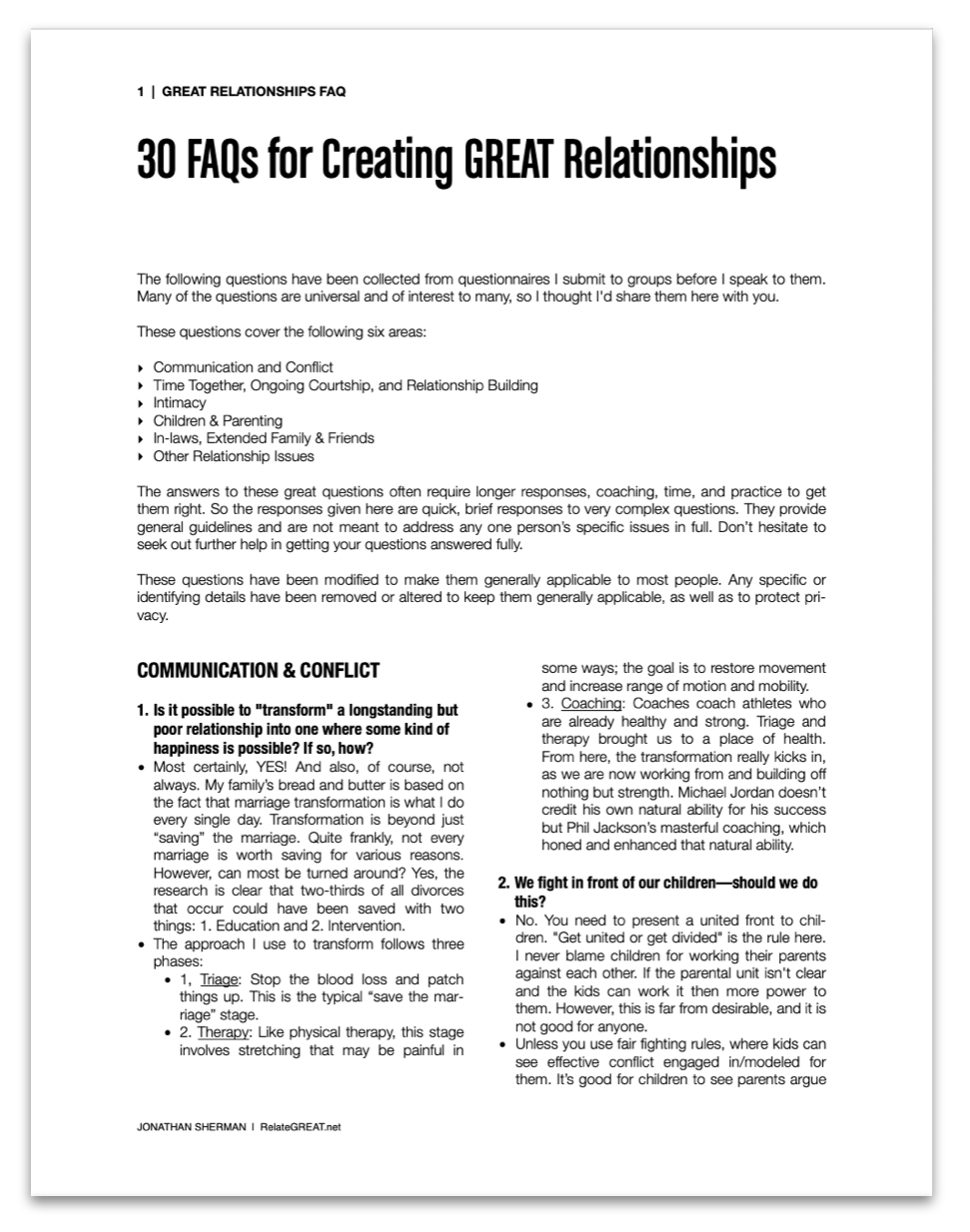
30 FAQs for Creating GREAT Relationships
The questions in this FAQ have been collected from questionnaires I submit to groups before I speak to them. Many of the questions are universal and of interest to many, so I thought I'd share them here with you. These questions cover the following six areas:
Communication and Conflict
Time Together, Ongoing Courtship, and Relationship Building
Intimacy
Children & Parenting
In-laws, Extended Family & Friends
Other Relationship Issues
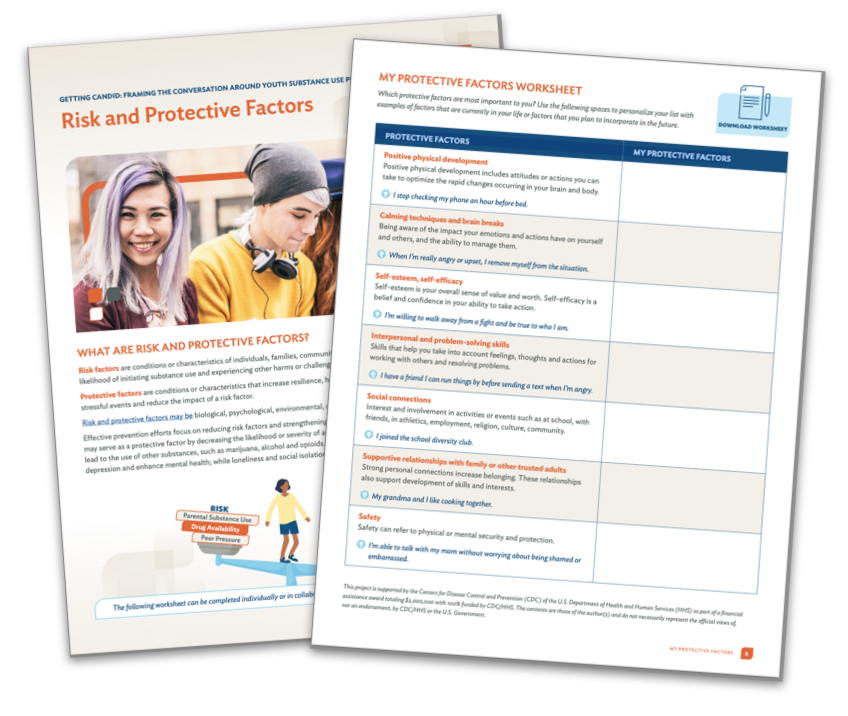
PDF: Risk and Protective Factors Worksheet
Provided by the National Council for Mental Well-Being (source: https://www.thenationalcouncil.org/resources/risk-and-protective-factors/).
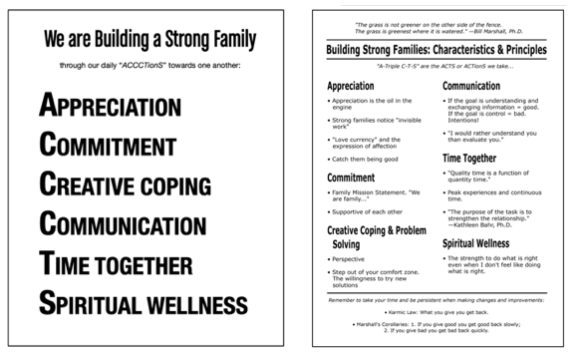
PDF of the Fridge Flyer Reminder Sheets
This is all a lot to remember! You can post one or both of these fridge flyers on your refrigerator to help you and your family remember these principles and practices as you continue to build and strengthen your family.
Vid: Strong families are REAL families with real problems…
Instead of “The Brady Bunch,” let’s take a look at a scene from the movie Parenthood where where Gil, the father, just quit his job and comes home to a messy home with many children underfoot and gets into an argument with his wife. While the rest of the movie highlights a lot of dysfunctional aspects in the extended family, it also shows how strong and resilient the primary family really is. This movie has many excellent scenes of strength, problems, and family dynamics that may be closer to what many of us experience in our own families.
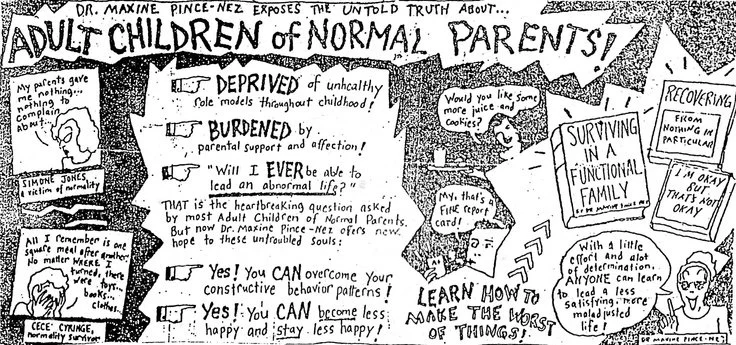
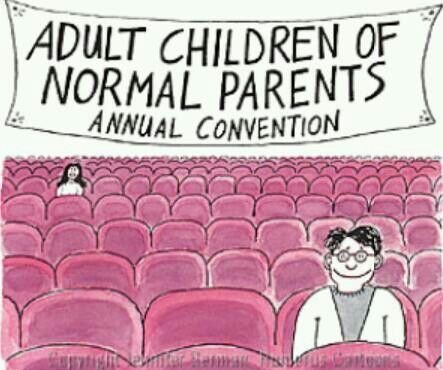
What’s “normal” anyway?
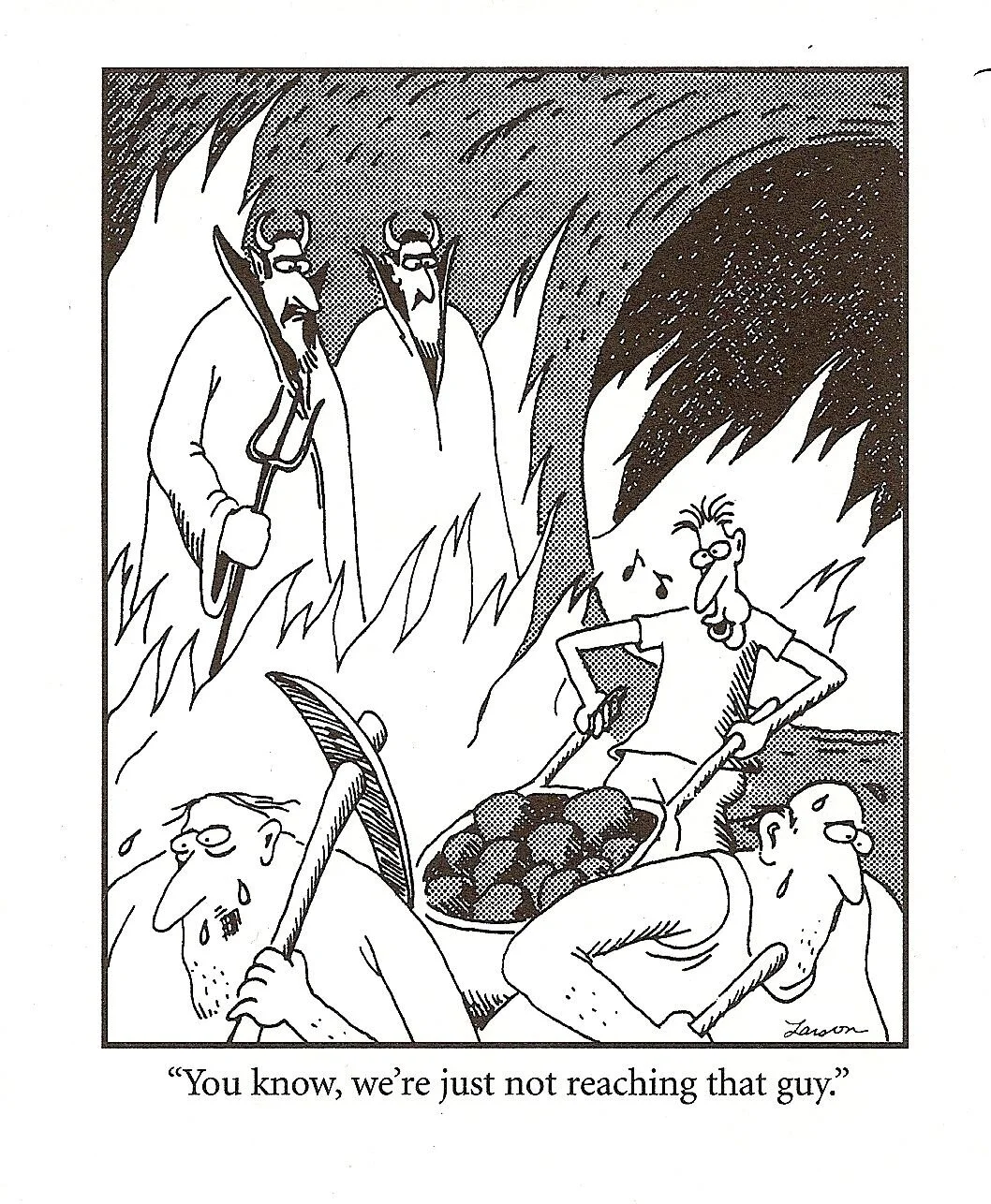
Too many people worry that their family isn’t normal. In all my years as a family therapist, I’ve alleviated the concerns of many families: Don’t worry about it. Don’t try to be “normal.” Don’t waste time comparing to others. Just work on being kind, being there for each other, working on your patience, and you’ll do just fine. In the meantime, enjoy these cartoons I used to share in my live workshops to illustrate this point:
PDF: The Family Strengths Inventory
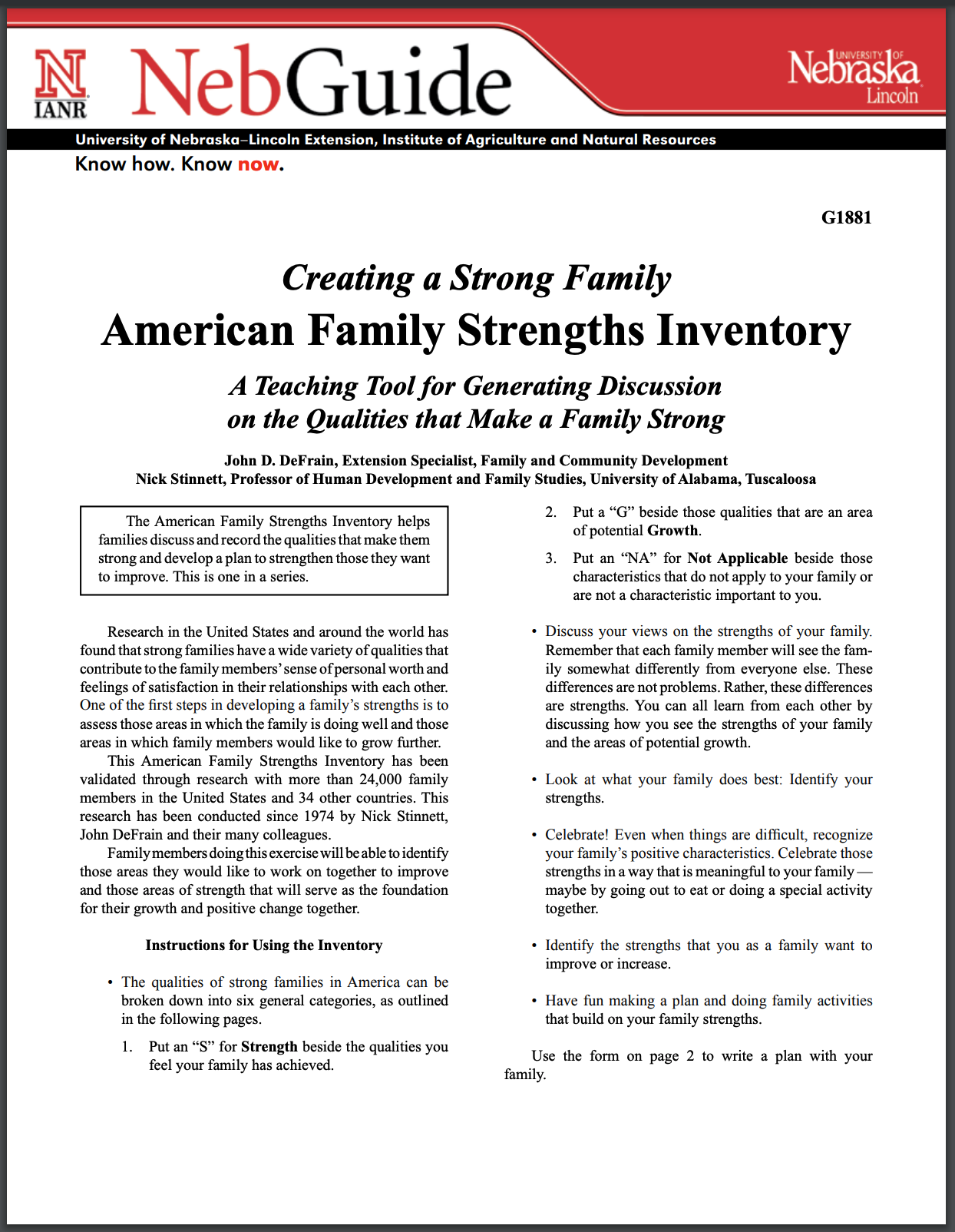
Take it with your family to celebrate what you are doing well and explore ways to grow together.
PDF: Journal article by one of the pioneers of the research into strong families:
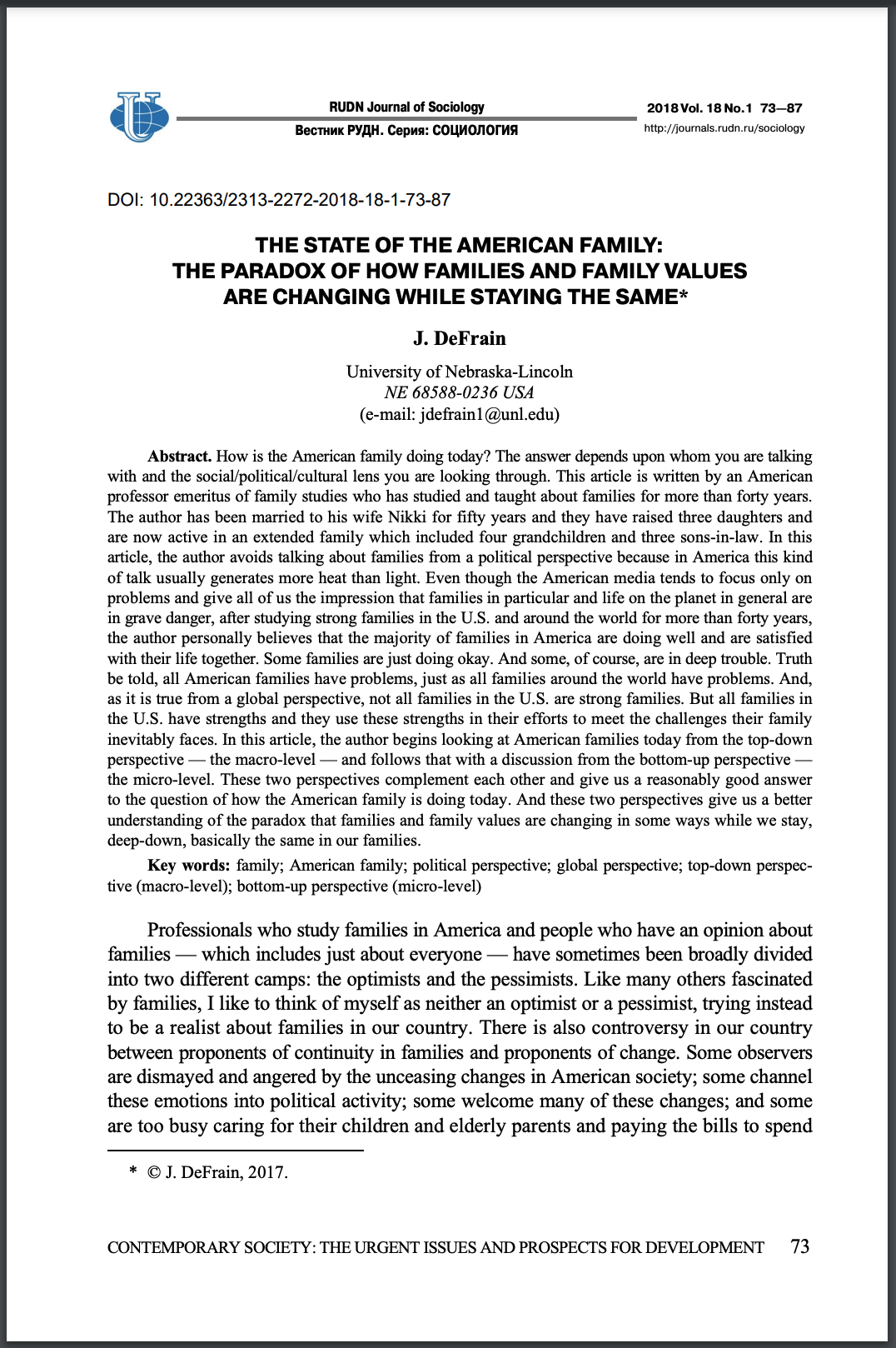
The State of the American Family: The Paradox of How Families and Family Values are Changing while Staying the Same, by John DeFrain, Ph.D.
From the Conclusion chapter:
Only a Person Who Risks is Free
passionately read by Leo Buscaglia

A1 & A2: Appreciation & Affection
Appreciation and Affection are about…
Appreciation and Affection are about…
CONTENTS ON THIS PAGE:
Story: Hugs and Praise Raise Good Kids
Story: Noticing Invisible Work
Story: Youth Need Appreciation, too
Vid: Making memories and remembering them: “But Not Forgotten”
Vid: Treating each other special: “The Parking Spot”
Vid: Being grateful for each other’s talents: “Little Mr. Microchip”
Vid: An Experiment in Gratitude: The Science of Happiness
Activity: Pass-Around Appreciation Notes
Story: Appreciation Takes Just a Minute
Story: The Power of Appreciation: All It Takes Is One Small Note
Activity: Quick Bonding Activity: "All About..."
Articles: Four Appreciation-related Blog Posts
Appreciation Example: The 52 Love Songs Project (20 so far and counting…)
Appreciation Example: The 365 Love Quotes Project (37 so far and counting…)
…emphasizing what is right.
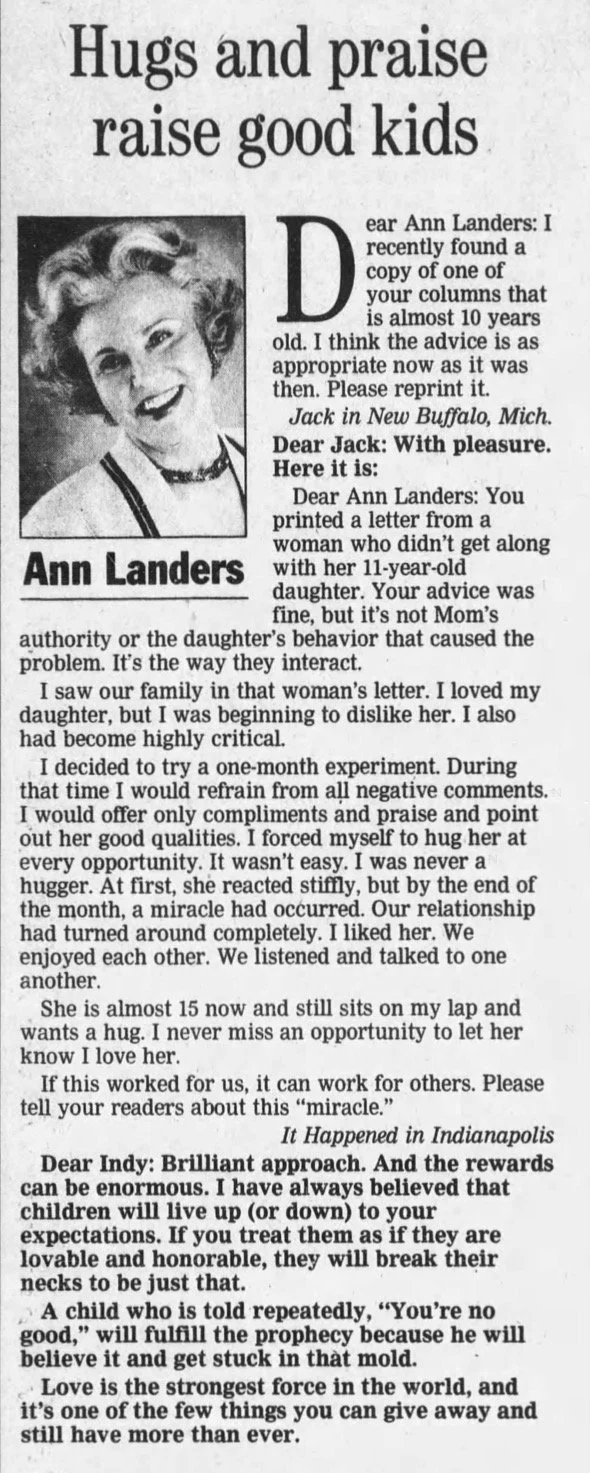
Hugs and Praise Raise Good Kids
Ann Landers newspaper column
Source: Chicago Tribune, May 8, 1996.
This is what inspired The 30-Day Experiment that I mention in the Building Strong Families book.
… noticing “invisible work.”
This husband and father shared:
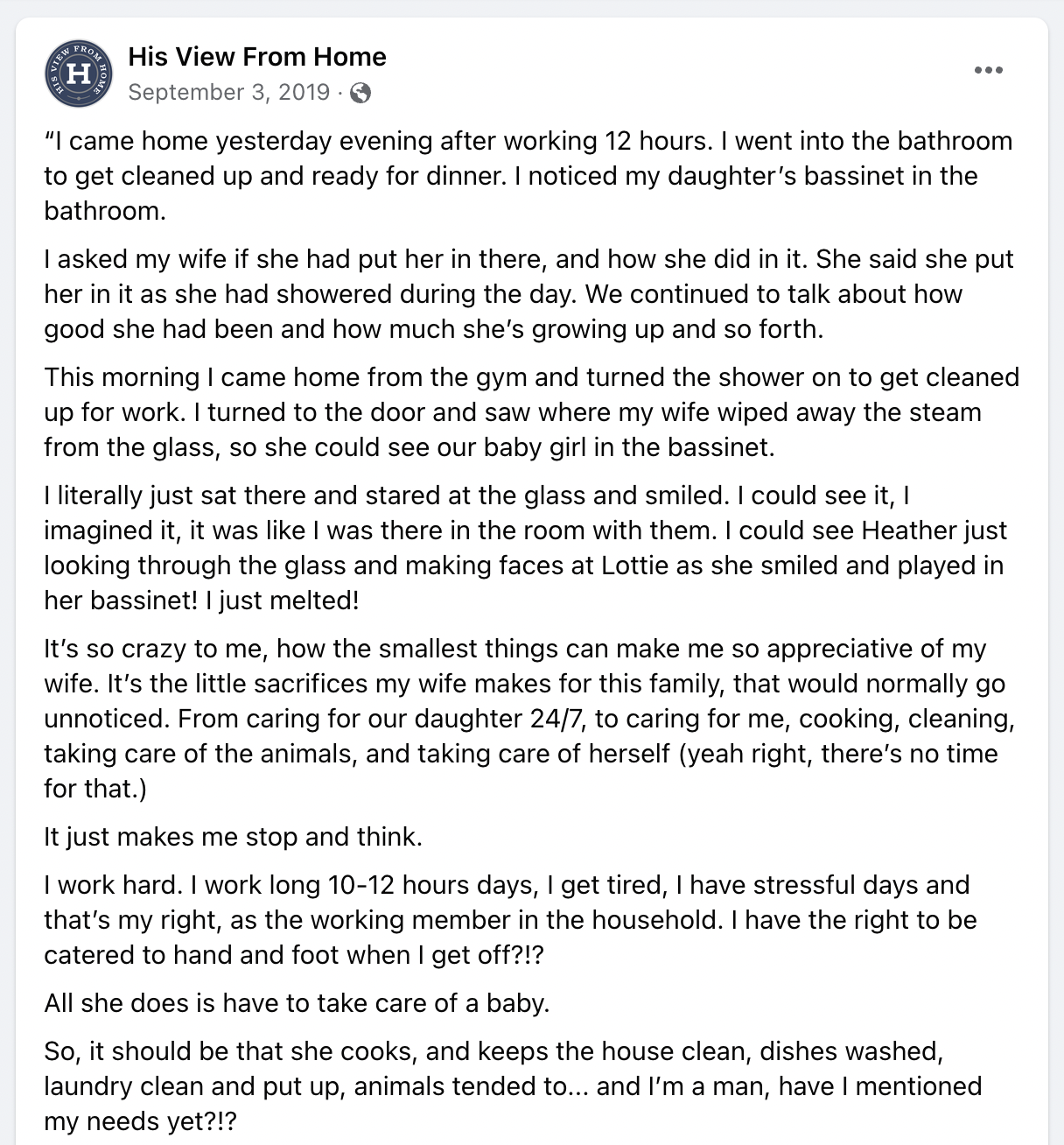
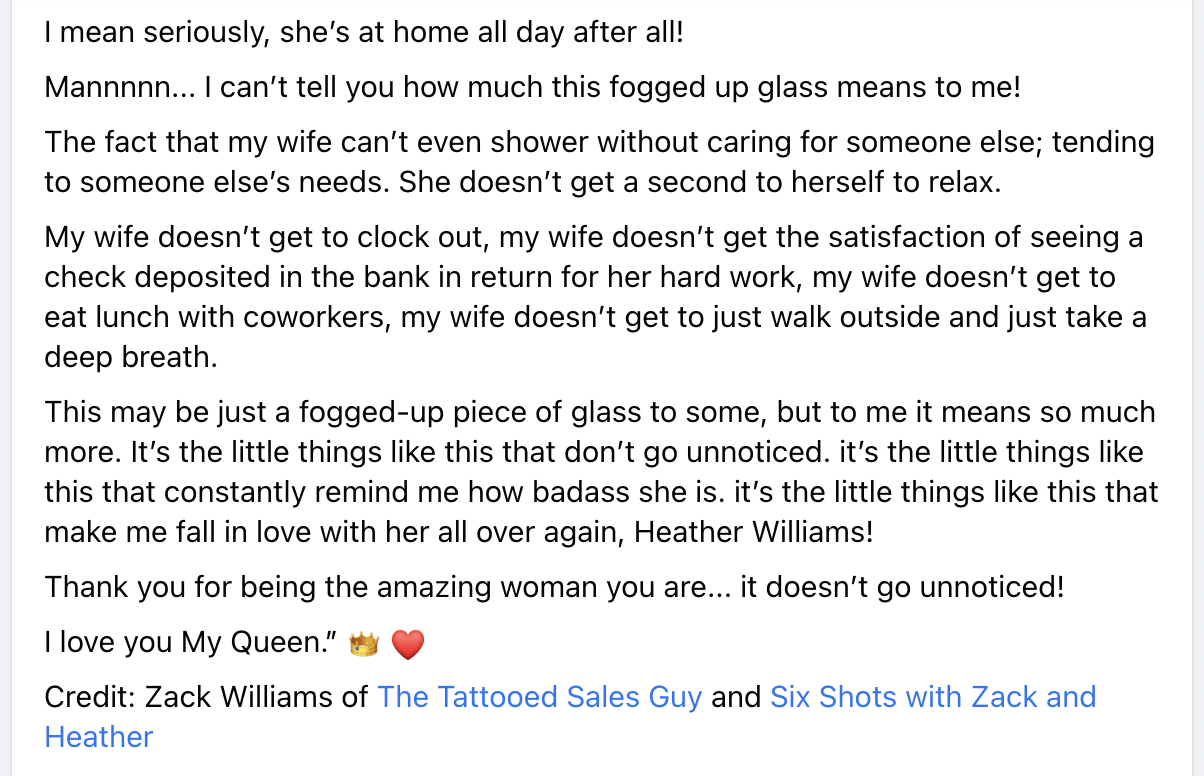
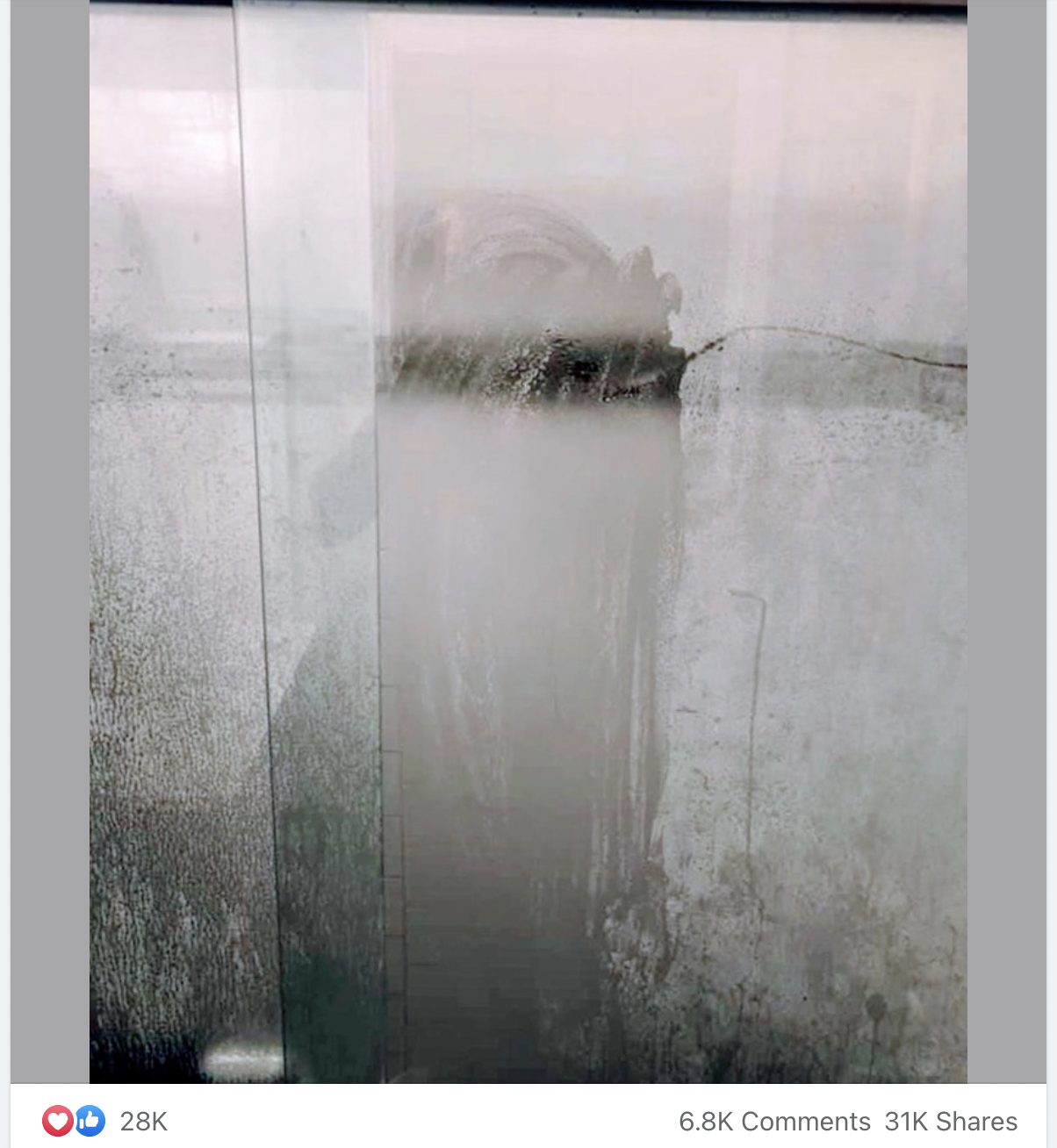
… expressing it! The youth feel it and notice.
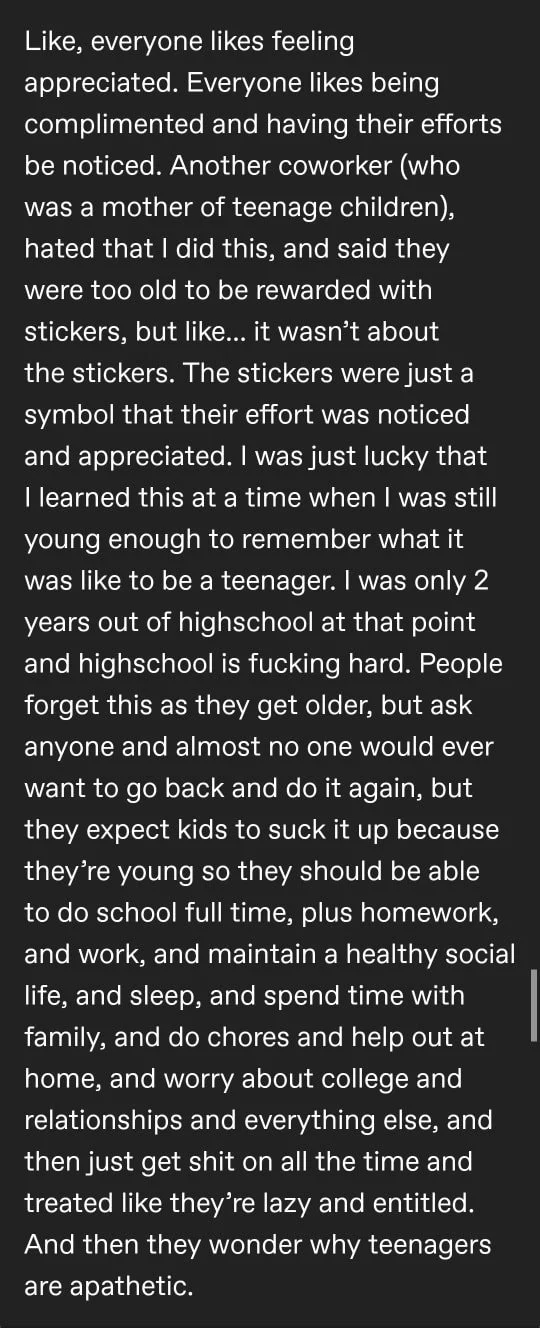
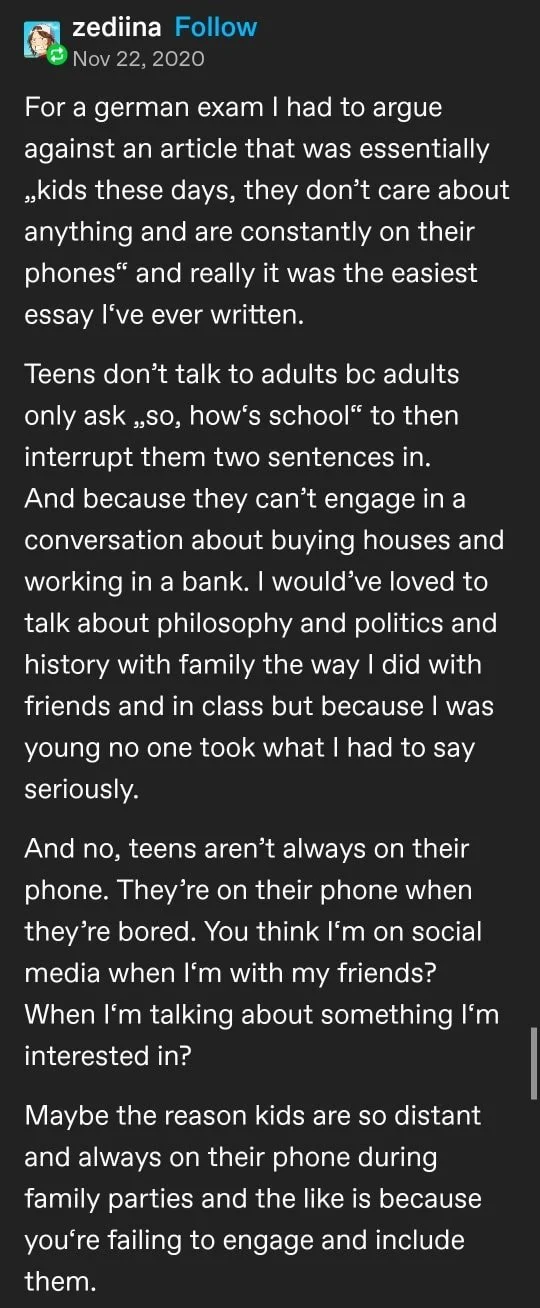
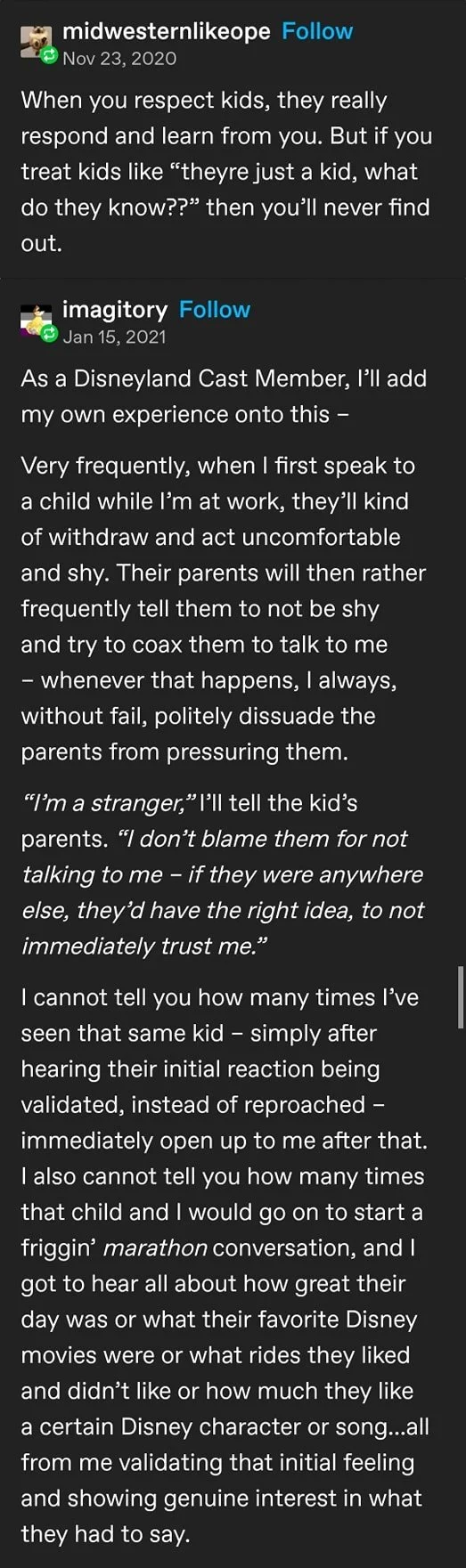
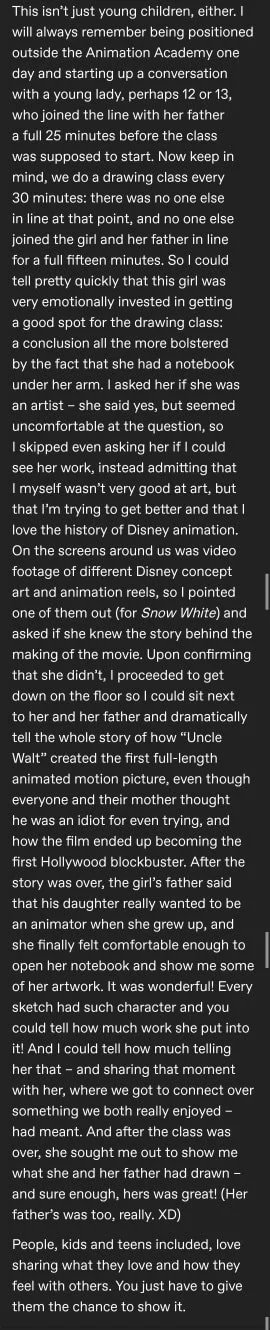
An invaluable perspective from our youth:
A former college dormmate, who now is an actual rocket scientist (an aerospace engineer who works for NASA!), shared this powerful post about the power of appreciation (both the presence and lack of it) from a group conversation thread from today’s youth:

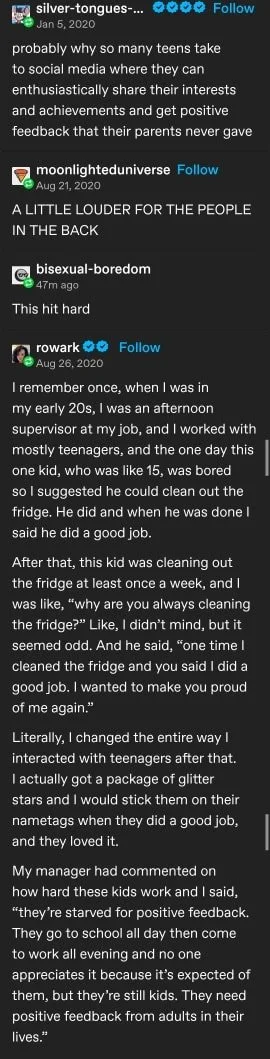
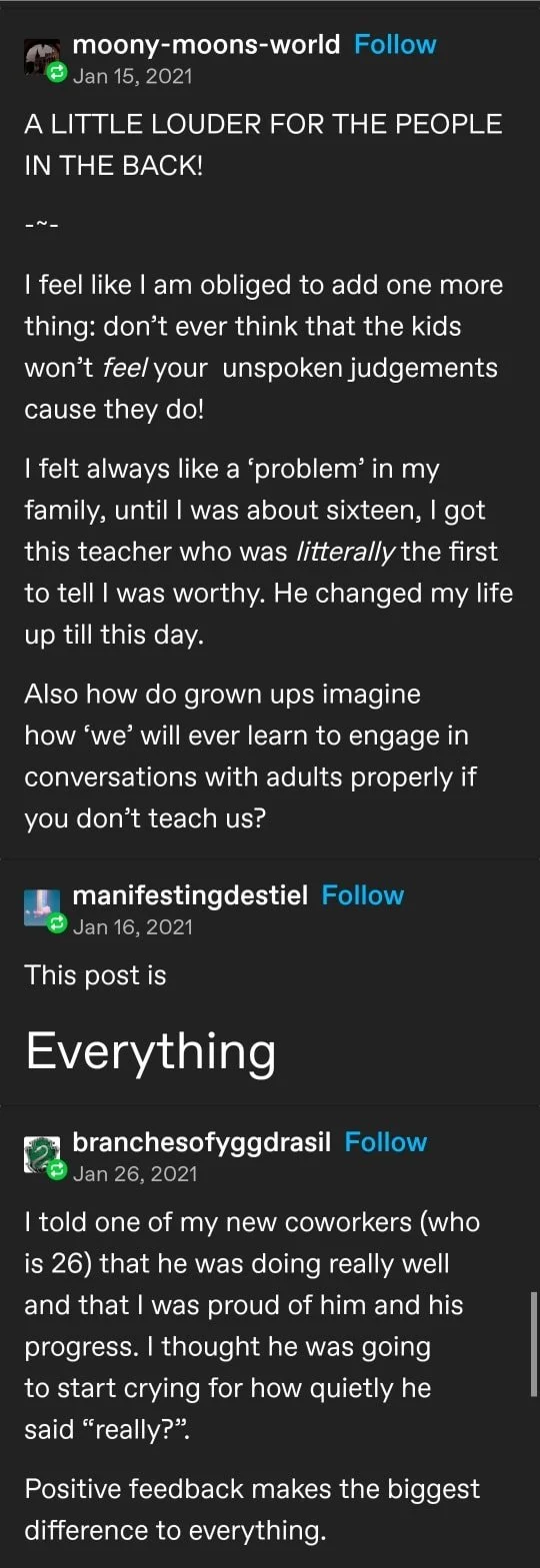
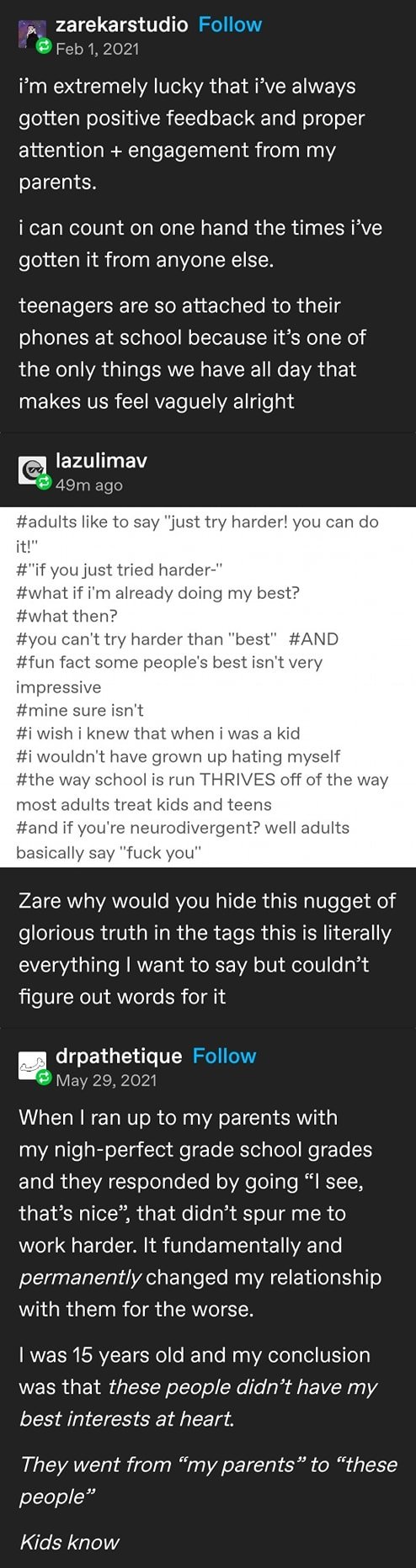
… Making memories and remembering them.
… Treating each other special.
… Being grateful for each other’s talents.
… Expressing gratitude as a method of creating happiness.
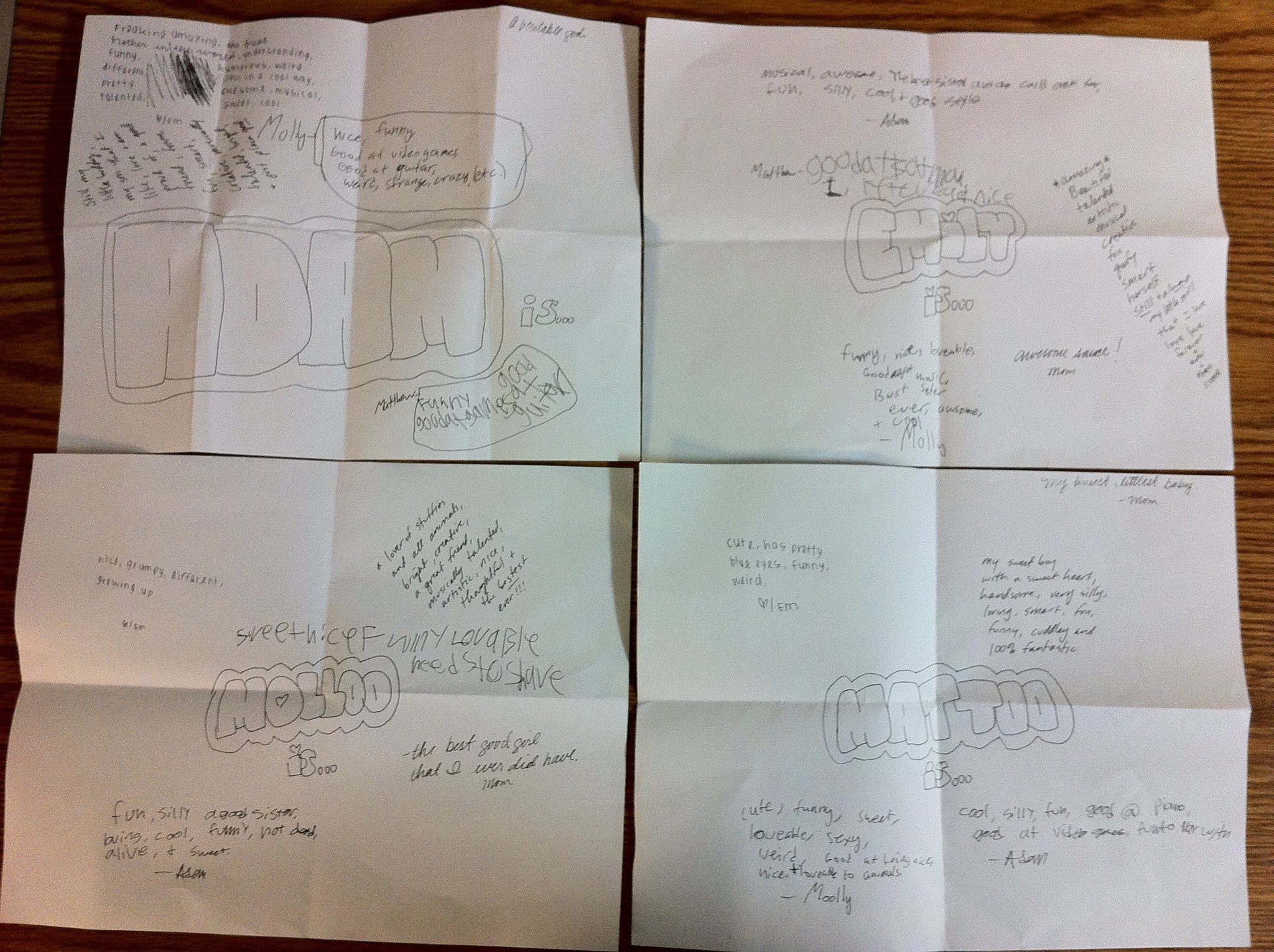
Activity: Pass-Around Appreciation Notes:
I posted this several years ago:
A simple way of expressing love, appreciation, recognition, and praise. Simply start a sheet with "Name is..." and pass it around. We did these in church today. Teens love (and need) it just as much as the little kids do. In 17 years of counseling, never once has someone said, "Our problem is my family appreciates me too much! I'm so sick and tired of all the sincere recognition, praise, and expressions of affection. I'm outta here!" Nope, not once. But have I heard the exact opposite? Yep, sadly, each and every day. People are appreciation starved. Flood the ones you love with appreciation. Don't make them beg for crumbs. Let them feast!
Source: https://www.facebook.com/photo?fbid=214711685227680&set=a.149709481727901
Appreciation Takes Just a Minute
I took as many opportunities to not only express appreciation to my children, but to facilitate my children expressing apprecation to one another. I found this brief text interchange I saved (from 5-21-11) between my then 17-year-old son, Adam, and me. It’s now 2021. It only took a short minute to communicate such long-lasting memory.
Me: Matthew [his younger brother] told me he got a fortune cookie this week that said, "The current year will bring you much happiness." He then said, "I'm pretty happy about the Assassin's Creed hidden blade Adam made me." :-) How's that make you feel, Big Bro?
Adam: Makes me feel good. Tell him that made me smile and thanks :)
Me: :-). I told him. He smiled his sweet smile and laughed. I've always been proud of the kind of brother you've always been, Adam.
Adam: Thanks dad. I learn from the best (you) :)
Me: :-).Thx pal!
Adam: You’re welcome.
The Power of Appreciation: All It Takes Is One Small Note
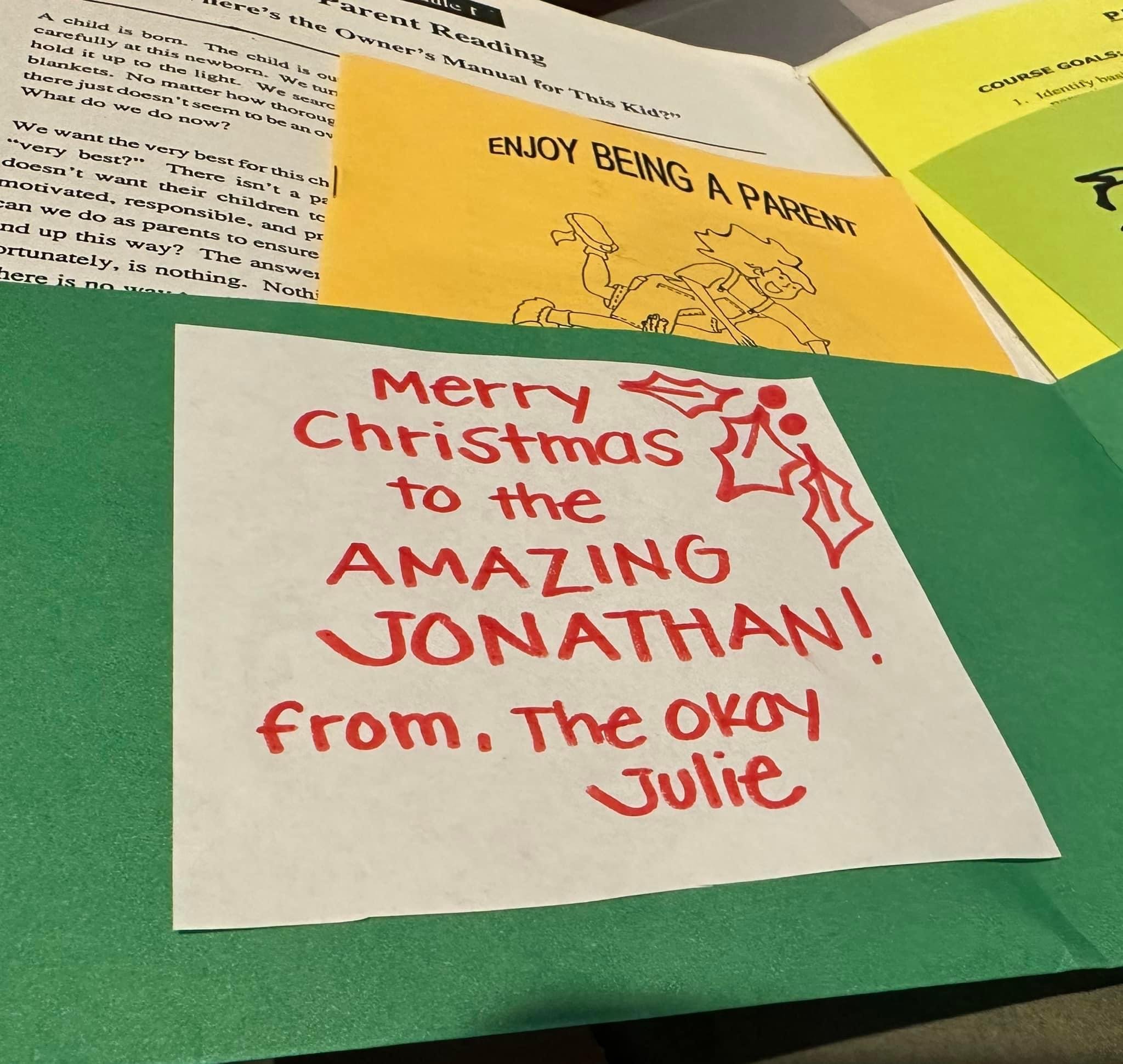
As I was cleaning out my file cabinets just now, I came across this encouraging little note from one of my parenting mentors, Julie Blanton. Julie was a Prevention Specialist at the community mental health center I worked at for many years, where she taught parenting classes for our clients and in the community. She let me shadow her class so I could learn all the parenting goodies for both my clients as well as for Kara’s and my young family. Julie herself had teens at the time, and we had little kids. She was a light of hope and encouragement that we were doing fine in the chaos and angst of parenting. She gave us hope for the looming teen years. She was real and down-to-earth. She was funny, kind, and wise. She was an encourager, lifter, and believer in people.
As she put this parenting folder together for her class, she took a few extra moments to add this little label inside mine. While discarding the rest of the contents, I’ll keep this precious little gem in my Feel Good File forever.
All these years later, you are still encouraging and lifting me, my friend.
I encourage us all to take a page out of Julie’s book and take a moment to write someone a little note of appreciation. It takes so little time. You never know… it might make much more than just their day today; they may hang on to that little treasure and find it again two whole decades from now, and it will again make their day 🙂
Julie has no idea I just found this and that I’m taking a mom to write this post to praise and thank her. But she will. I’m sending this to make HER day right now…
Quick Bonding Activity: "All About..."
Occasionally, in church, I like to pass around to each family member a piece of paper titled, "All About (Name): (Name) Is..."
And then let each family member add whatever kind observation about that person.
The benefits are simple and important: The writer is able to reflect on the good qualities of that person and the recipient gets to feel great and appreciated. It's a quick, simple, yet meaningful, way to feel connected and to further solidify the family bond and loyalty to one another. It's also interesting and fun to find out what each other notices about each other.
So today, I did one on myself as dad and one for the kids mom. Here's what we learned about each other from our kids.
"Hey Kids: Your Dad Is..."
From my son (16): "interesting, a good drawer, cool, a good sword fighter, good at helping with problems."
From my daughter (14): "something, funny, goofy, dorky, 'smrat', Jona-thin/Jona-fat, creative."
From my daughter (11): "strange, funny, smart, creative, and helpful."
From myson(9): "smart, funny, weird, awesome."
"All About Mom: Mom Is..."
16: "good food and laundry--heh heh--just kidding but really too, loving, caring, funny, a good dancer, can make my friends laugh."
14: "she's prettyyyyyy :), silly , a good cook, good at shopping, distracted a lot, goofy, loving"
11: "funny, nice, pretty, loving, dog loving, sweet, good cook."
9: "she calls dad 'Pootie', she's pretty, funny, likes 'bunnies', best food ever!"
I don't know anyone who tires of hearing nice things said about them. You just can't over-appreciate someone, folks.
Give it a try and share how it goes for ya.
Appreciation-related Blog Posts

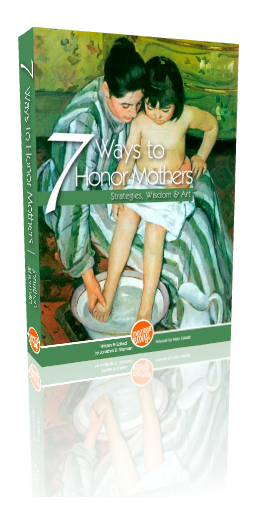



Appreciation Example: The 52 Love Songs Project













Appreciation Example: The 365 Love Quotes Project


















C1: Commitment
Commitment is about...
Commitment is about...
CONTENTS ON THIS PAGE:
Having a Compelling Mission Statement
Audio: Our son Matthew on our family mission statement
Music Video: “We Are Family,” by Sister Sledge
Making Your Word Mean Something
Music Video: “When I Said I Do,” by Clint Black
Music Video: “Still the One,” by Orleans
Blog Articles: The 52 Love Songs Project
Blog Articles: The 52 GREAT Relationship Masters Project (19 and counting…)
Book: Horton Hatches the Egg
Working Things Out
Music Video: “We Can Work It Out,” The Beatles
Music Video : “We Can Work It Out,” cover by Stevie Wonder
Vid: Blockbuster (TV spot)
Being There
Vid: A Son Every Day (TV spot)
Vid: Half Time (TV spot)
Vid: Dry Cleaner (TV spot)
Vid Casey at the Bat (TV spot)
Vid: Cheering Section (TV spot)
Vid: Family Harmony (TV spot)
Movies and Shows About Strong Families
… Having a compelling Mission Statement…
…so everyone knows what we’re about and our commitment to each other.
Example 1.
I found this audio journal entry of what my then 17-year-old son, Matthew, thought our family’s mission statement might be:
Example 2.
The 70s disco hit, We Are Family by Sister Sledge is an excellent example of a powerful mission statement.
… Making our word mean something.
Most romantic songs are about strong feelings… and feelings come and go. While I’m a hopeless romantic, love love and all the sappy feelings that go with it, those feelings aren’t reliable as they can rise and fall, ebb and flow. Instead, I’m much more interested in songs about COMMITTED love. Behavioral love. Choice-based love. And this is one of my very favorite of all of them. “When I said, ‘I do’ I meant, ‘I will.’”
… Means you’re still the one
“Still the One,” by Orleans
“Changing, our love is going gold*
Even though we grow old, it grows new”
* Note: “love is going gold” is a reference to the golden or 50th anniversary.

See my 52 Love Songs Project for many more examples of COMMITTED love songs.
“I meant what I said,
And I said what I meant.
An elephant’s faithful,
One hundred percent.”
—Horton the Elephant, Dr. Seuss
Never read it?! Click here to get it now! —>
It’s a fun read-aloud book with a great message.


The 52 GREAT Relationship Masters Project










… Working things out,
such as "mend it, don't end it."
Example 1:
I love this Stevie Wonder cover of The Beatles “We Can Work It Out.” It’s a great anthem to remember to hang in there and not give up. Of course, the original is superb… so here they both are together :-).
Example 2:
… Being there,
helping each other out, showing up, supporting each other, believing in one another, cheering each other on, having a place... All of this gives us security, a safe harbor in a storm, a sense of purpose, place and identity.
Movies and Shows About Strong Families
There are fortunately many good movies and TV shows about strong families that exhibit messages of commitment to one another. Please share your faves in the Private Facebook Group.
Soul Food (1997)
Generations bonding around the dinner table through food. Clip:
The Pursuit of Happyness (2006)
Single father in poverty fights for a better future for his son.
Life Is Beautiful
Tragically sad and beautiful story of parents, highlighting the father’s incredible attitude, protecting their son from the horrors of the Holocaust.
Marley and Me
The life of a family around a chaotic but endearing loveable dog. This movie highlights the idea of “mend it, don’t end it” when it comes to marital conflict.
My Big Fat Greek Wedding (2002)
Western groom enters into his bride’s traditional Greek family where the bonds are very strong.
Little Miss Sunshine (2006)
A family learns to come together in a common goal, in spite of their differences and conflicts.
The Family Stone (2005)
Different personalities, common family bond. Mother’s last Christmas as family copes with loss and acceptance, while new girlfriend struggles to fit in.
Kramer vs. Kramer (1979)
Dustin Hoffman and Meryl Streep struggle through the conflict of divorce and custody battles while working hard to be there for the son they both love and eventually find a way to co-parent.
Parenthood
Steve Martin plays the father who anxiously tries to be the father to the children he never had.
The Royal Tenenbaums (2001)
A comedy and drama that addresses dysfunction, divorce, death, and the power of family.
What's Eating Gilbert Grape (1993)
Gilbert (Johnny Depp) sacrifices his desire to make a life of his own to care for his mentally impaired brother (Leonardo DiCaprio) and disabled mother.
C2: Creative Coping
Creative Coping & Problem-Solving is about…
Creative Coping & Problem-Solving is about…
CONTENTS ON THIS PAGE:
Creative Reframes and Perspectives
Cartoons: Two
Vid: Leo Buscaglia on being “kooky”
Music Video: “Another Day in Paradise,” by Phil Vasser
Story: The Barometer Problem
Preventing problems vs. reacting to problems
Vid: Jonathan’s reaction video on “Family Portrait” by Pink
Vid: Comedy skit “Don’t Buy Stuff”
Poem: “Fences or Ambulances?”
Channeling anger, learning skills, maintaining perspective, developing patience, and fostering understanding.
PDF: Stress Test: The Perceived Stress Scale (PSS-10)
Link: Recommended Reading
Vid: Lasting Marriage (TV spot)
Vid: Please Sit Down (TV spot)
Vid: Like Father Like Son (TV spot)
Vid: Potato Chip Trail (TV spot)
… Creative reframes and perspectives
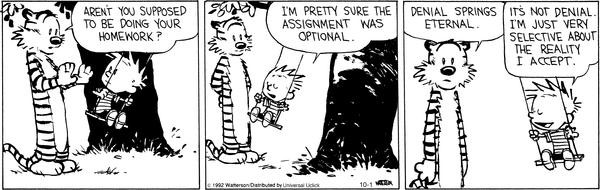
Calvin and Hobbes by Bill Watterson for October 01, 2012




Leo Buscaglia, one of my heroes, on how being “kooky” (or authentic) helps him be much happier than those who worry about how they fit in.
Just Another Day in Paradise, by Phil Vassar
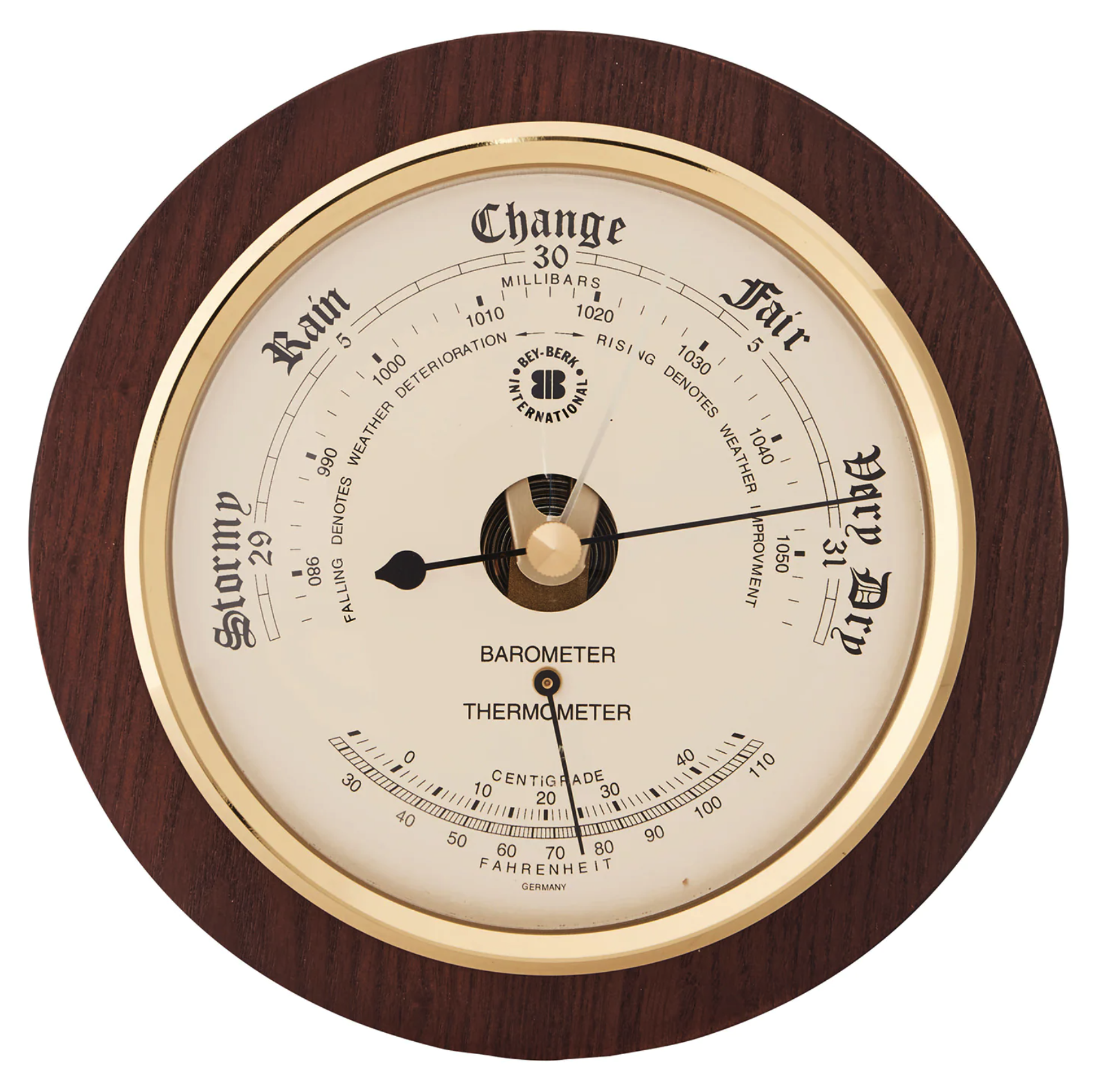
The Barometer Problem
Sir Ernest Rutherford, President of the Royal Academy, and recipient of the Nobel Prize in Physics, related the following story:
“Some time ago I received a call from a colleague. He was about to give a student a zero for his answer to a physics question, while the student claimed a perfect score. The instructor and the student agreed to an impartial arbiter, and I was selected. I read the examination question: “Show how it is possible to determine the height of a tall building with the aid of a barometer.”
The student had answered: “Take the barometer to the top of the building, attach a long rope to it, lower it to the street, and then bring it up, measuring the length of the rope. The length of the rope is the height of the building.”
The student really had a strong case for full credit since he had really answered the question completely and correctly! On the other hand, if full credit were given, it could well contribute to a high grade in his physics course and certify competence in physics, but the answer did not confirm this.
I suggested that the student have another try. I gave the student six minutes to answer the question with the warning that the answer should show some knowledge of physics. At the end of five minutes, he hadn’t written anything. I asked if he wished to give up, but he said he had many answers to this problem; he was just thinking of the best one. I excused myself for interrupting him and asked him to please go on. In the next minute, he dashed off his answer, which read: “Take the barometer to the top of the building and lean over the edge of the roof. Drop the barometer, timing its fall with a stopwatch. Then, using the formula x=0.5*a*t^2, calculate the height of the building.”
At this point, I asked my colleague if he would give up. He conceded and gave the student almost full credit. While leaving my colleague’s office, I recalled that the student had said that he had other answers to the problem, so I asked him what they were. “Well,” said the student, “there are many ways of getting the height of a tall building with the aid of a barometer. For example, you could take the barometer out on a sunny day and measure the height of the barometer, the length of its shadow, and the length of the shadow of the building, and by the use of simple proportion, determine the height of the building.”
“Fine,” I said, “and others?”
“Yes,” said the student, “there is a very basic measurement method you will like. In this method, you take the barometer and begin to walk up the stairs. As you climb the stairs, you mark off the length of the barometer along the wall. You then count the number of marks, and this will give you the height of the building in barometer units.”
“A very direct method.”
“Of course. If you want a more sophisticated method, you can tie the barometer to the end of a string, swing it as a pendulum, and determine the value of g [gravity] at the street level and at the top of the building. From the difference between the two values of g, the height of the building, in principle, can be calculated.”
“On this same tack, you could take the barometer to the top of the building, attach a long rope to it, lower it to just above the street, and then swing it as a pendulum. You could then calculate the height of the building by the period of the precession”.
“Finally,” he concluded, “there are many other ways of solving the problem. Probably the best,” he said, “is to take the barometer to the basement and knock on the superintendent’s door. When the superintendent answers, you speak to him as follows: ‘Mr. Superintendent, here is a fine barometer. If you will tell me the height of the building, I will give you this barometer.”
At this point, I asked the student if he really did not know the conventional answer to this question. He admitted that he did, but said that he was fed up with high school and college instructors trying to teach him how to think. The name of the student was Niels Bohr.”
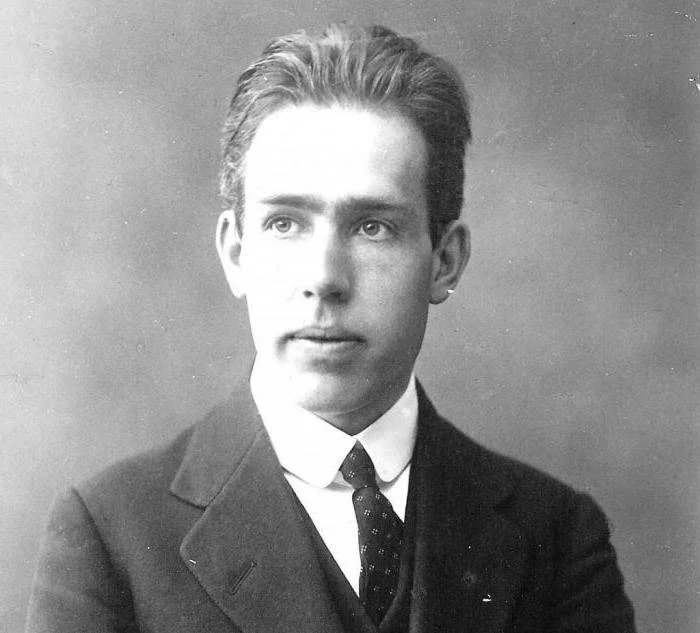
Who was Niels Bohr? 1885-1962 Danish Physicist; Nobel Prize 1922; best known for proposing the first ‘model’ of the atom with protons & neutrons, and various energy state of the surrounding electrons-the familiar icon of the small nucleus circled by three elliptical orbits ... but more significantly, an innovator and revolutionary in Quantum Theory.
… Preventing problems vs. reacting to problems
Learning from Cautionary Tales
Watch Jonathan’s reaction video to Pink’s Family Portrait. Powerful lessons from family conflicts and divorce. While not all marriages can or should be saved, many can. And either way, kids need to be kept out of the conflict. Better yet, learn how to address and resolve problems respectfully so kids don’t get caught in the middle and can learn a better model.
“Don’t Buy Stuff”
SNL Skit with Steve Martin, Amy Poehler, and Chris Parnell

FENCES OR AMBULANCES?
by Joseph Malins
'Twas a dangerous cliff, as they freely confessed,
Though to walk near its crest was so pleasant;
But over its terrible edge there had slipped
A duke and full many a peasant.
So the people said something would have to be done,
But their projects did not at all tally;
Some said, "Put a fence around the edge of the cliff, "
Some, "An ambulance down in the valley. "
But the cry for the ambulance carried the day,
For it spread through the neighboring city;
A fence may be useful or not, it is true,
But each heart became brimful of pity
For those who slipped over that dangerous cliff;
And the dwellers in highway and alley
Gave pounds or gave pence, not to put up a fence,
But an ambulance down in the valley.
"For the cliff is all right, if you 're careful," they said,
"And, iffolks even slip or are dropping,
It isn 't the slipping that hurts them so much,
As the shock down below when they're stopping."
So day after day, as these mishaps occurred,
Quick forth would these rescuers sally
To pick up the victims who fell off the cliff,
With their ambulance down in the valley.
Then an old sage remarked: "It's a marvel to me
That people give far more attention
To repairing results than to stopping the cause,
When they 'd much better aim at prevention.
Let us stop at its source all this mischief, " cried he,
"Come, neighbors andiriends, let us rally;
If the cliff we will fence we might almost dispense
With the ambulance down in the valley. "
"Oh, he's a fanatic, " the others rejoined,
"Dispense with the ambulance? Never!
He'd dispense with all charities, too, if he could;
No! No! We '11 support them forever.
Aren 't we picking up folks just as fast as they fall?
And shall this man dictate to us? Shall he?
Why should people of sense stop to put up a fence,
While the ambulance works in the valley?"
But a sensible few, who are practical, too,
Will not bear with such nonsense much longer;
They believe that prevention is better than cure,
And their party will soon be the stronger.
Encourage them then, with your purse, voice, and pen,
And while other philanthropists dally,
They will scorn all pretense and put up a stout fence
On a cliff that hangs over the valley.
Better guide well the young than reclaim them when old,
For the voice of true wisdom is calling,
"To rescue the fallen is good, but 'tis best
To prevent other people from falling "
Better close up the source of temptation and crime
Than deliver from dungeon and galley;
Better put a strong fence round the top of the cliff
Than an ambulance down in the valley.
Source: The Best Loved Poems of the American People. New York: Doubleday, 1936, pp. 273-274.
… Channeling anger, learning skills, maintaining perspective, developing patience, and fostering understanding.
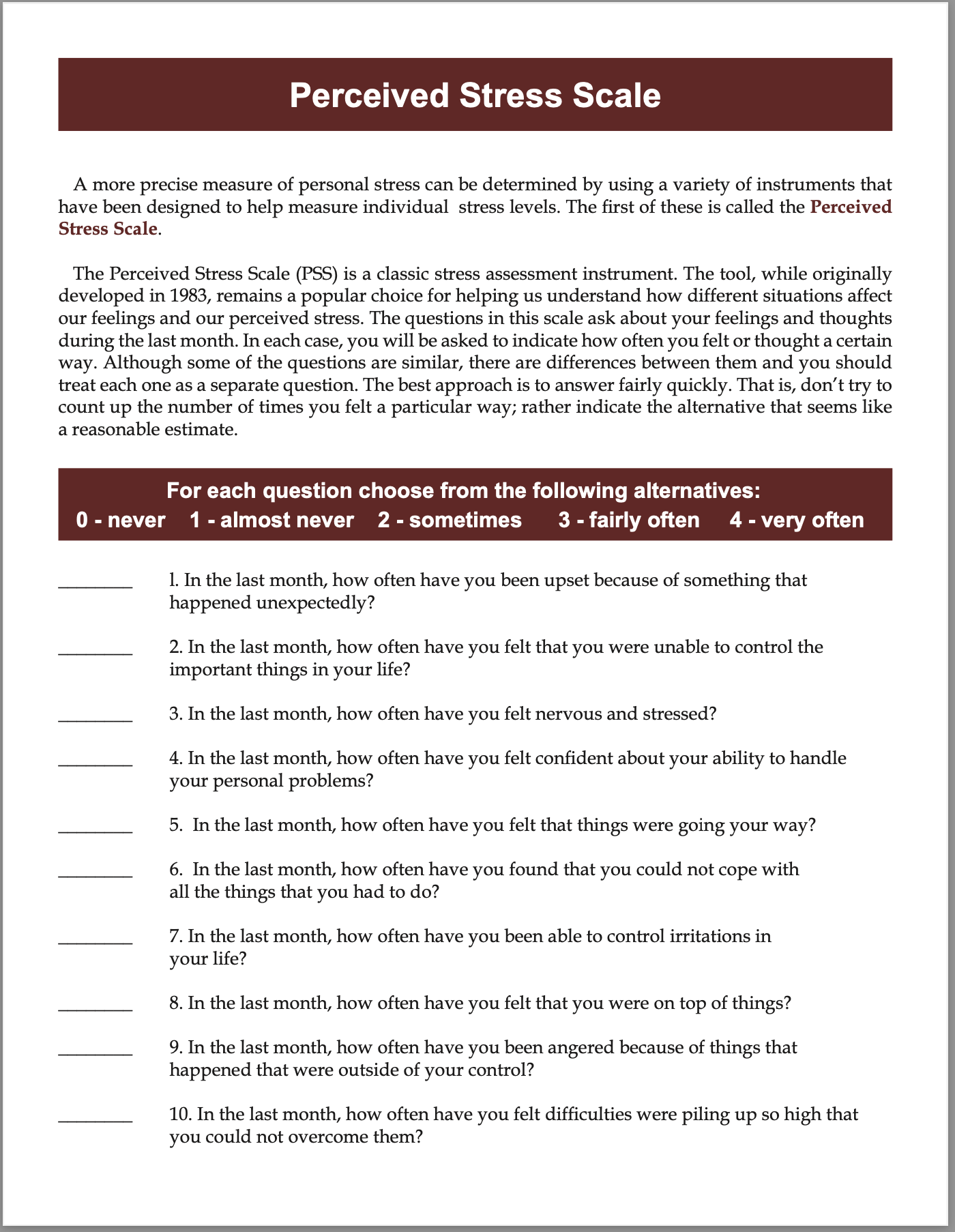
Stress Test: The Perceived Stress Scale (PSS-10)
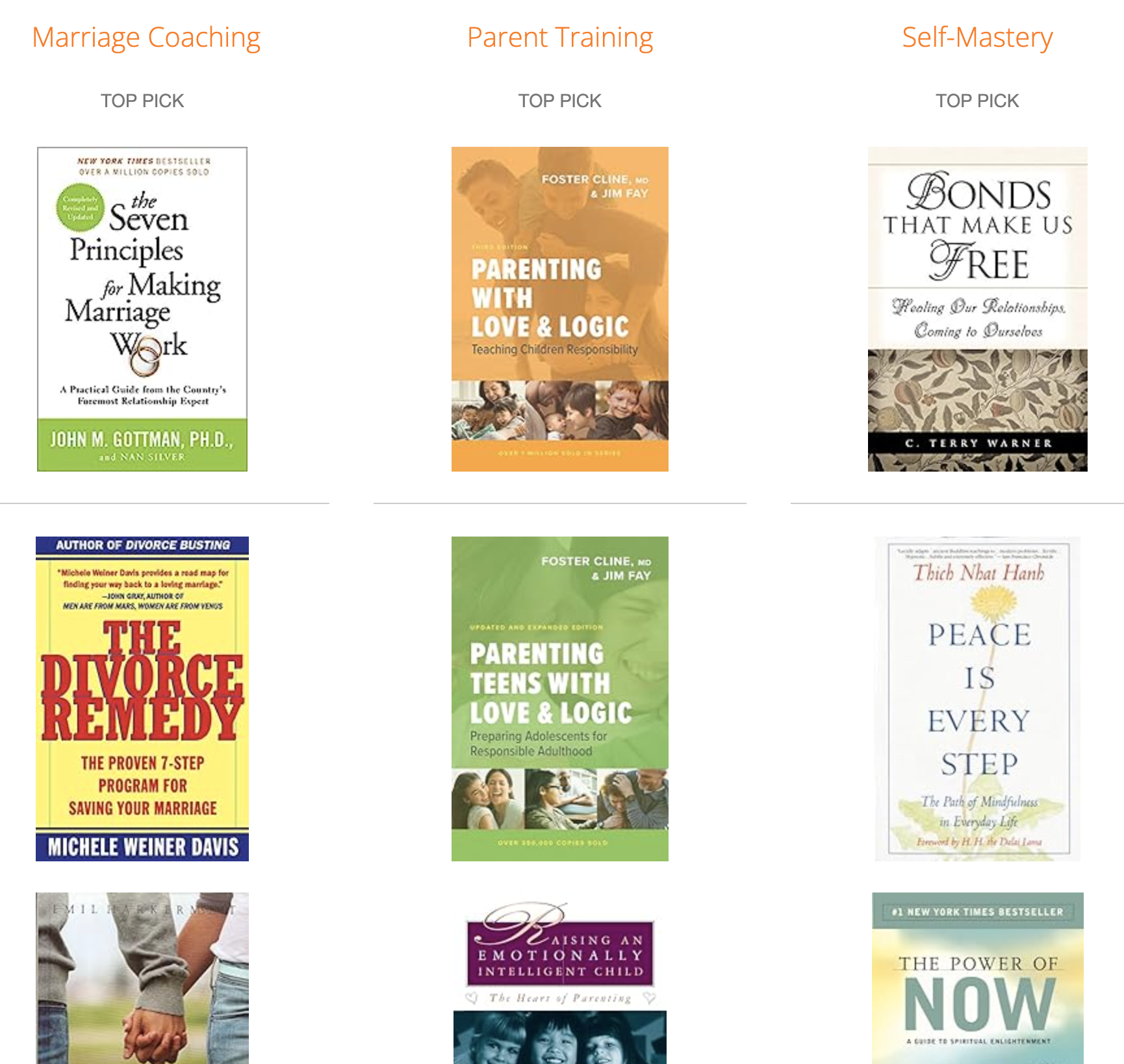
Recommended Reading
For dealing effectively with stress and conflict, there’s just no substitute for the best knowledge and the best skills. See my list of my top picks an other favorites in these three areas:
Vids

C3: Communication
Communication is about…
Communication is about…
CONTENTS ON THIS PAGE:
Learning how to relate when it’s hard to relate
Cartoon
Vid: Phone Call (TV spot)
Vid: Cookies (TV spot)
Vid: Truck Talk (TV spot)
Vid: The Fence (TV spot)
Vid: Saturday Mornings (TV spot)
Vid: Going to the Dogs (TV spot)
Listening: the grand communication key
Vid: Communication Skills: Empathetic Listening
Vid: Talk the Time to Listen (TV spot)
Vid: What to Say (TV spot)
Vid: Amy Ruins Raiders (clip from The Big Bang Theory)
Vid: Listening is the Beginning of Understanding (TV spot)
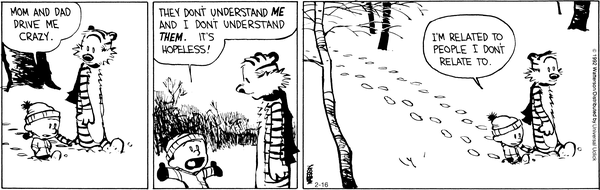
… Learning how to relate when it’s hard to relate.
… Listening: the grand communication key.
An example of the power of empathic, validating, present listening joining the person where they are…
Funny example of not listening, and then exaggerated active listening (that actually kinda works), and then…

T: Time Together
Time Together is about…
Time Together is about…
CONTENTS ON THIS PAGE:
The best present you can give
Vid: Thich Nhat Hanh: “The Best Present.”
Time with Kids: You never get it back
Story: “Why don’t you kids grow up?!” / No More Oatmeal Kisses, by Erma Bombeck
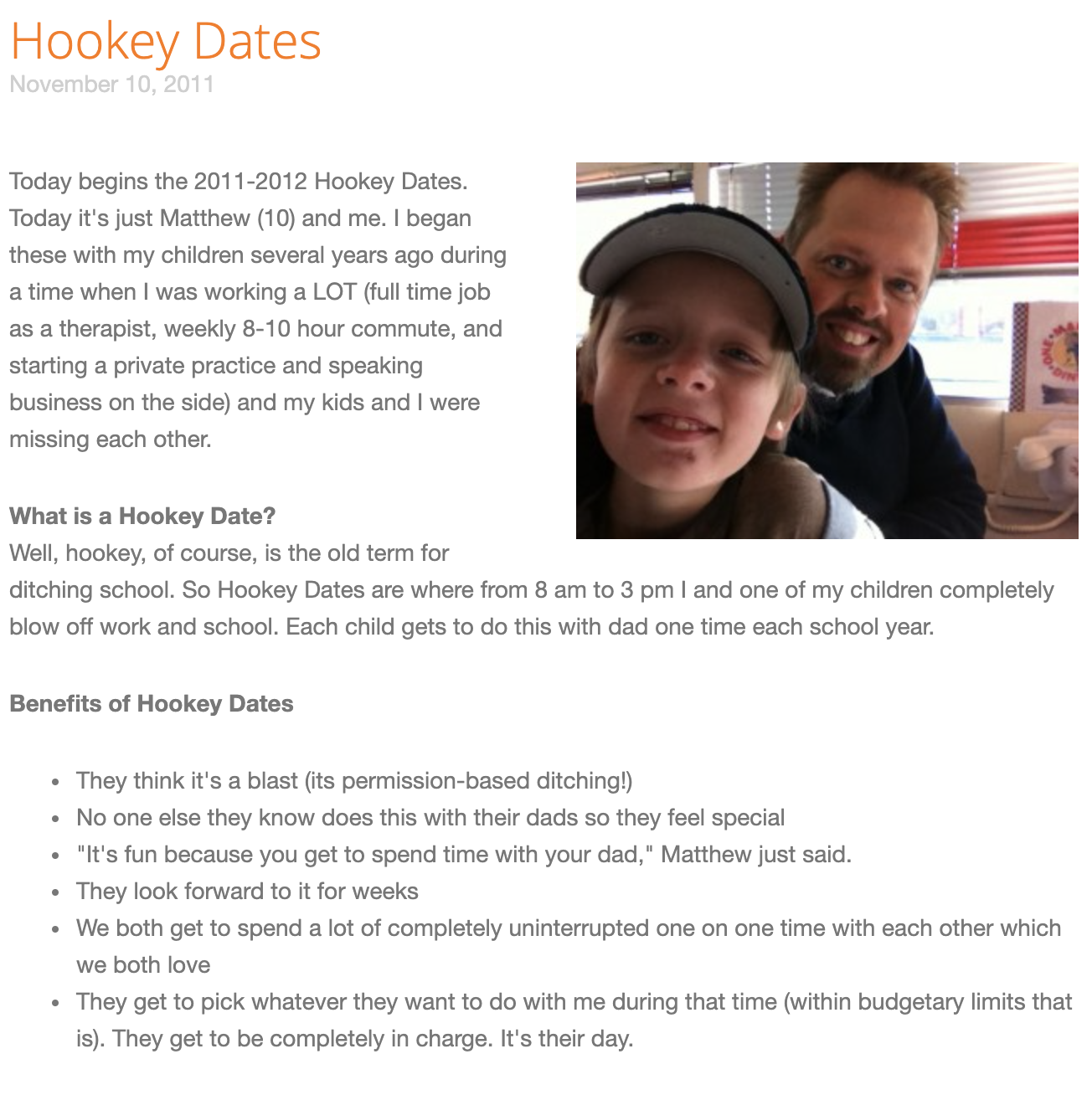
Blog post: Hookey Dates
Vid: “If you could have dinner with anyone in the world…?” (TV commercial)
Vid: Consequences - Daughter (TV spot)
Vid: Waiting for Dad (TV spot)
Vid: I’ve Put It Off Too Long (TV spot)
Vid: Home Repair (TV spot)
Vid: Johnny Got a Job (TV spot)
Vid: But Why? (TV spot)
Vid: At the Movies (TV spot)
Vid: Answering Machine (TV spot)
Vid: Soccer (TV spot)
Vid: Born to Play the Game (TV spot)
Vid: Missing (TV spot)
Vid: By the Hour (TV spot)
Vid: Something Important (TV spot)
Vid: Don’t Let the Magic Pass You By (TV spot)
Time with kids: Enter their world.
Vid: Runaway Stage (TV spot)
Vid: SciFi (TV spot)
Vid: Swashbuckler (TV spot)
Vid: Dinner Conversation (TV spot)
Vid: Bad Hair Day (TV spot)
Time as a Couple
Vid: Secret Agent (TV spot)
Time Together as a Family
Vid: Pool (TV spot)
Just being there
Music Vid: “Lady” by The Little River Band
…. The best present you can give.
Thich Naht Hanh, the well-known Buddhist monk, shares this valuable insight:
… Time with Kids: You never get it back.
Take the time to make the time, because you'll never "find" the time. By spending your valuable time with your kids you create memories with your kids you can enjoy reflecting on the rest of your life and thus avoid looking back with regrets of "if only I had spent more time with my kids..."
Why don’t you kids grow up?!
When I (Jonathan Sherman) was a young father I read the following piece by Erma Bombeck, who was a newspaper columnist, bestselling author, and humorist. It really hit me! I vowed then and there to not be the dad who looked forward to when the children left, nor the dad who looked back regretting missed time with his children now that those moments are gone and it’s too late. I’m not a fan of “guilty parenting” so I’m not sharing it to trigger guilt for what you've done wrong as a parent (we all have!). I don’t want you to use it that way. I encourage you to use it the way it helped me: 1. As a cautionary tale I could learn from to save myself from feeling guilty later, and 2. as a mindfulness practice: to embrace and be in the moment I was in with the child that was in front of me as they were in that now moment. Now that my kids are grown, and we are empty-nesters, I’m very grateful I can look back and reflect on how I stopped to be with them, how much we both enjoyed that time, how many good memories we have, and how much it built such a strong bond in our relationships.
No More Oatmeal Kisses
by Erma Bombeck from Forever, Erma (1996)
A young mother writes: "I know you've written before about the empty-nest syndrome, that lonely period after the children are grown and gone. Right now I'm up to my eyeballs in laundry and muddy boots. The baby is teething, the boys are fighting. My husband just called and said to eat without him, and I fell off my diet. Lay it on me again, will you?"
OK. One of these days, you'll shout, "Why don't you kids grow up and act your age!" And they will. Or, "You guys get outside and find yourselves something to do . . . and don't slam the door!" And they won't.
You'll straighten up the boys' bedroom neat and tidy: bumper stickers discarded, bedspread tucked and smooth, toys displayed on the shelves. Hangers in the closet. Animals caged. And you'll say out loud, "Now I want it to stay this way." And it will.
You'll prepare dinner with a salad that hasn't been picked to death and a cake with no finger traces in the icing, and you'll say, "Now, there's a meal for company." And you'll eat it alone.
You'll say, "I want complete privacy on the phone. No dancing around. No demolition crews. Silence! Do you hear?" And you'll have it.
No more plastic tablecloths stained with spaghetti. No more bedspreads to protect the sofa from damp bottoms. No more gates to stumble over at the top of the basement steps. No more clothespins under the sofa. No more playpens to arrange a room around.
No more anxious nights in the bathroom. No more iron-on patches, rubber bands for ponytails, tight boots or wet knotted shoestrings.
Imagine. A lipstick with a point on it. No baby-sitter for New Year's Eve. Washing only once a week. Seeing a steak that isn't ground. Having your teeth cleaned without a baby on your lap. No PTA meetings. No carpools. No blaring radios. No one washing her hair at 11 o'clock at night. Having your own roll of Scotch tape.
Think about it. No more Christmas presents out of toothpicks and library paste. No more sloppy oatmeal kisses. No more tooth fairy. No more giggles in the dark. No knees to heal, no responsibility.
Only a voice crying, "Why don't you grow up?" and the silence echoing, "I did."
Hookey Dates
Enjoy this blog post about our family tradition of playing hookey from school and work… and the impact it has had on our relationship.
“If you could have dinner with anyone in the world…?”
Masterfoods commercial
… Time with kids: Enter their world.
… Time as a Couple.
… Time together as a family.
… Just being there.
Take time to make time
Make time to be there
This line from the 70s love song Lady, by The Little River Band, has been a constant mantra in my head in my family life. Life gets so busy and people complain to me they can’t “find” the time. The truth is there’s no time to find. And besides “finding” time is a passive reaction to life and relationships. Instead, we have to take the time to make the time. That’s a proactive, choice-based, empowered response to life and relationships.
Enjoy this great song!

S: Spiritual Wellness
Spiritual Wellness is about…
Spiritual Wellness is about…
CONTENTS ON THIS PAGE:
Story: Values Are Caught More Often Than They Are Taught
Vids: Honesty and Integrity (2)
Vids: Loving your children enough to ask the important questions (3)
Vid: Forgiveness
Vid: Compassion, generosity, and service
Podcast: When children leave your faith
Quotes: Wisdom on Families & Spiritual Wellness from Many Faiths
Pic: Servant Leader (Jesus washing Peter’s feet)
… Teaching your children values, most often by showing vs. talking.
As someone once said, "Values are caught more often than they are taught." Values such as honesty, kindness, service, patience, compassion.
Values Are Caught More Often Than They Are Taught
Charles Beckert tells this story:
When Johnny was six years old he was with his father and they were caught speeding. The father handed the police officer a five-dollar bill with his driver's license. "It's okay, son," the father said as they drove off, "everybody does it."
When he was eight he was permitted at a family council presided over by Uncle George on the surest means to shave points off the income tax return. "It's okay kid," the uncle said, "everybody does it."
When he was nine his mother took him to his first theater production. The box office man couldn't find any seats until his mother discovered an extra two dollars in her purse and bribed him. "It's okay son," she said, "everybody does it."
When he was 12 he broke his glasses on the way to school. His Aunt Francine convinced the insurance company they had been stolen and collected 27 dollars [it's an old story]. "It's okay, kid," she said, "everybody does it."
When he was 15 he was right guard on the high school football team. His coach showed him how to block and at the same time grab the opposing end so the officials couldn't see it. "It's okay kid," he said, "everybody does it."
When he was 16 he took his first summer job at the big market. His assignment: to put the overripe tomatoes in the bottom of the boxes, the good ones on top where they would show. "It's okay, kid," the manager said, "everybody does it."
When he was 18 Johnny and a neighbor applied for a college academic scholarship. Johnny was a marginal student. The neighbor was in the upper three percent of his class. The neighbor couldn't play right guard. Johnny got the assignment and the scholarship. "It's okay," the university told him.
When he was 19 he was approached by an upperclassman who offered the test answers for three dollars. "It's okay, kid, everbody here does it."
Johnny was caught, expelled, sent home in disgrace. "How could you do this to your mother and me?" his father asked. "You never learned anytyhing like that at home." His aunt and uncle were also shocked. "If there's one thing the adult world can't stand it's a kid who cheats."
Beckert continues [paraphrased]: "Now I say values are caught more often than taught. We must send direct signals of what we value. We can't hide behind the fact that I'm older and you're younger therefore I have a right to violate my values."
Source: Beckert, Charles (1988). Strategies for Successful Families. Audiotape recording. Covenant Recordings, Inc.
… Honesty and integrity.
Telling the truth can be hard.
… Loving your children enough to ask the important questions,
which are sometimes the hard questions.
… Forgiveness.
… Compassion, generosity, and service.

“So many young people are walking away from faith in recent years. We invited Jonathan and Kara Sherman to talk with us about how to handle it when a child goes through a faith transition and how to keep parent-child relationships strong despite differing points of view. Jonathan is a marriage and family therapist, and Kara has been a stay-at-home mom and a child advocate. They bring a wealth of personal and professional insight on this tender yet important topic.”
—Jen & Jess
… learning from other spiritual traditions.
Wisdom on Families & Spiritual Wellness from Many Faiths
Spirituality has always been a part of the human experience. We crave meaning in an uncertain world. That meaning helps us cope. And as social creatures, that meaning helps us connect. Around the world and throughout history, many spiritual traditions have arisen to help us humans do just that: cope and connect. Here are a few quotes
FAMILY HARMONY
“Supporting one’s father and mother, cherishing wife and children, and a peaceful occupation—this is the greatest blessing.“
—Buddhism. The Buddha, Sutta Nipata 262
“The greatest work that you or I will ever do will be within the walls of our own homes.“
—Christianity. Heber J. Grant, The Church of Jesus Christ of Latter-day Saints
“May in this family, discipline overcome indiscipline, peace discord, charity miserliness, devotion arrogance, the truth-spoken word the false-spoken word which destroys the holy order.“
—Zoroastrianism. Avesta, Yasna 60.5
“Natural mildness should be there in the family. Observance of the vows leads to mildness…. Right belief should there be amongst family members. Crookedness and deception cause unhappiness in the family. Straightforwardness and honesty in one’s body, speech, and mental activities lead the family to an auspicious path. Purity, reverence, ceaseless pursuit of knowledge, charity, removal of obstacles that threaten equanimity, service to others —these make the family happy.“
—Jainism. Tattvarthasutra 6.18-24
“When wives and children and their sires are one,
’Tis like the harp and lute in unison.
When brothers live in concord and at peace
The strain of harmony shall never cease.
The lamp of happy union lights the home,
And bright days follow when the children come.“
—Confucianism. The Book of Songs
PARENTS AND CHILDREN
“Train up a child in the way he should go,
and when he is old, he will not depart from it.“
—Judaism and Christianity. Bible, Proverbs 22.6
In other words:
“You can only coil a fish when it is fresh.“
—African Traditional Religions. Nupe Proverb (Nigeria)
“As the child, according to its natural disposition, commits thousands of faults,
The father instructs and slights, but again hugs him to his bosom.“
—Sikhism. Adi Granth, Sorath, M.5
“Do not despise the breath of your fathers,
But draw it into your body.
That our roads may reach to where the life-giving road of our sun father comes out,
That, clasping one another tight,
Holding one another fast,
We may finish our roads together;
That this may be, I add to your breath now.
To this end:
May my father bless you with life;
May your road reach to Dawn Lake,
May your road be fulfilled.“
—Native American Religions. Zuni Prayer
“Honor your father and your mother, that your days may be long in the land which the Lord your God gives you.“
—Judaism and Christianity. Bible, Exodus 20.12
“If your parents take care of you up to the time you cut your teeth, you take care of them when they lose theirs.“
—African Traditional Religions. Akan Proverb (Ghana)
“There are three partners in man, God, father, and mother. When a man honors his father and mother, God says, ‘I regard it as though I had dwelt among them and they had honored me.’“
—Judaism. Talmud, Kiddushin 30b
“Do not neglect the [sacrificial] works due to the gods and the fathers! Let your mother be to you like unto a god! Let your father be to you like unto a god! Let your teacher be to you like unto a god!“
—Hinduism. Taittiriyaka Upanishad 1.11.2
“My father sent for me; I saw he was dying. I buried him in that beautiful valley of winding waters. I love that land more than all the rest of the world. A man who would not love his father’s grave is worse than a wild animal.“
—Native American Religions. Nez Perce Tradition
“Veneration of parents’ graves and the spirits of ancestors is an important expression of a son’s or daughter’s abiding love for their parents.“
—Native American. Nez Perce Tradition
SPOUSE/PARTNER
“Husbands love your wives even as Christ loved the Church and gave himself for it.“
—Christianity, Paul in Ephesians 5:25, New Testament
“Not those are true husband and wife that with each other [merely] consort: Truly wedded are those that in two frames, are as one light.
—Sikhism. Adi Granth, Var-Suhi-Ki, M.3, p. 788
“I am He, you are She;
I am Song, you are Verse,
I am Heaven, you are Earth.
We two shall here together dwell,
becoming parents of children.“
—Hinduism. Atharva Veda 14.2.71
“The moral man finds the moral law beginning in the relation between man and woman, but ending in the vast reaches of the universe.“
—Confucianism. Doctrine of the Mean 12
“Among His signs is that He created spouses for you among yourselves that you may console yourselves with them. He has planted affection and mercy between you.“
—Islam. The Prophet Muhammad, Qur’an 30.21
“He who loves his wife as himself; who honors her more than himself; who rears his children in the right path, and who marries them off at the proper time of their life, concerning him it is written: “And you will know that your home is at peace.“
—Judaism. Talmud, Yebamot 62
“Do not abuse your wife. Women are sacred. If you make your wife suffer, you will die in a short time. Our grandmother, Earth, is a woman, and in abusing your wife you are abusing her. By thus abusing our grandmother, who takes care of us, by your action you will be practically killing yourself.“
—Native American Religions. A Winnebago Father’s Precepts
“When women are honored, there the gods are pleased; but where they are not honored, no sacred rite yields rewards.“
—Hinduism. Laws of Manu 3.56
SPIRITUAL GROWTH
“Practicing step-by-step,
One gradually fulfills all Buddha teachings.
It is like first setting up a foundation
Then building the room:
Generosity and self-control, like this,
Are bases of enlightening beings’ practices.“
—Buddhism. Garland Sutra 10
“Through constant effort over many lifetimes, a person becomes purified of all selfish desires and attains the supreme goal of life.“
—Hinduism. Krishna, Bhagavad Gita 6.45
“By degrees, little by little, from time to time, a wise person should remove his own impurities as a smith removes the dross from silver.“
—Buddhism. Buddha, Dhammapada 239
“We glory in tribulations also: knowing that tribulation worketh patience; And patience, experience; and experience, hope: And hope maketh not ashamed; because the love of God is shed abroad in our hearts by the Holy Ghost which is given unto us.
—Christianity. Paul, Romans 5:3-5
“Study of Torah leads to precision, precision to zeal, zeal to cleanliness, cleanliness to restraint, restraint to purity, purity to holiness, holiness to meekness, meekness to fear of sin, fear of sin to saintliness, saintliness to the holy spirit, and the holy spirit to life eternal.“
—Judaism. Talmud, Aboda Zara 20b
Servant Leader
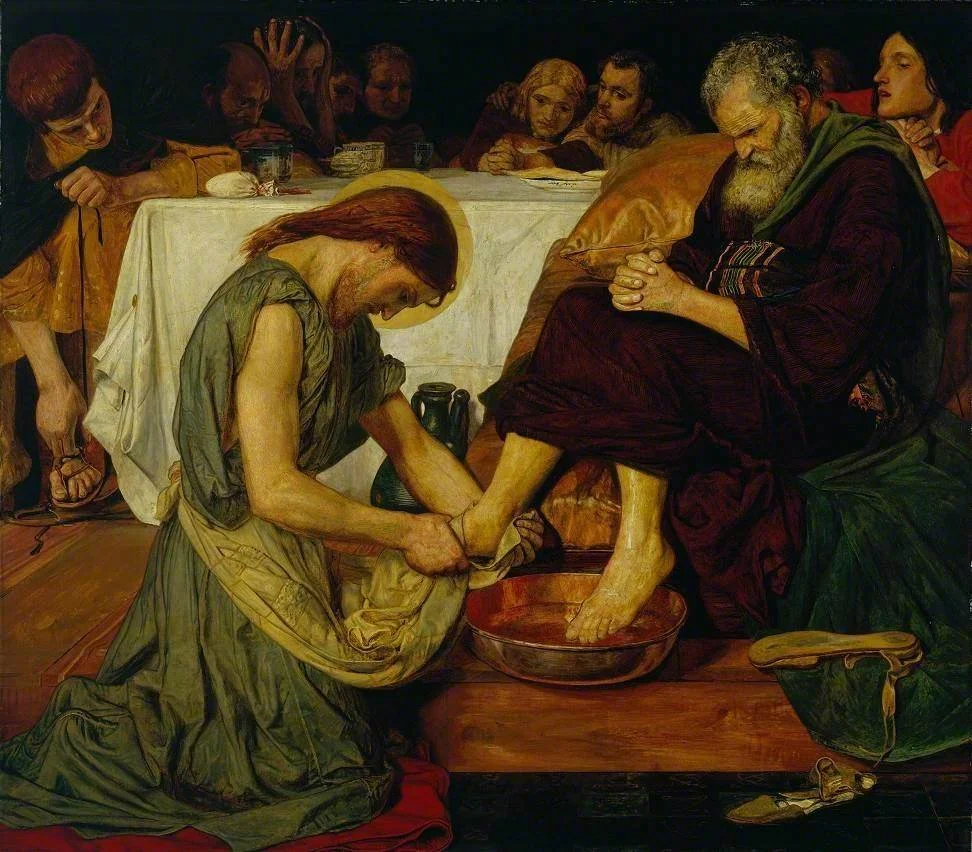
Jesus Washing Peter's Feet
Ford Madox Brown (1821–1893)